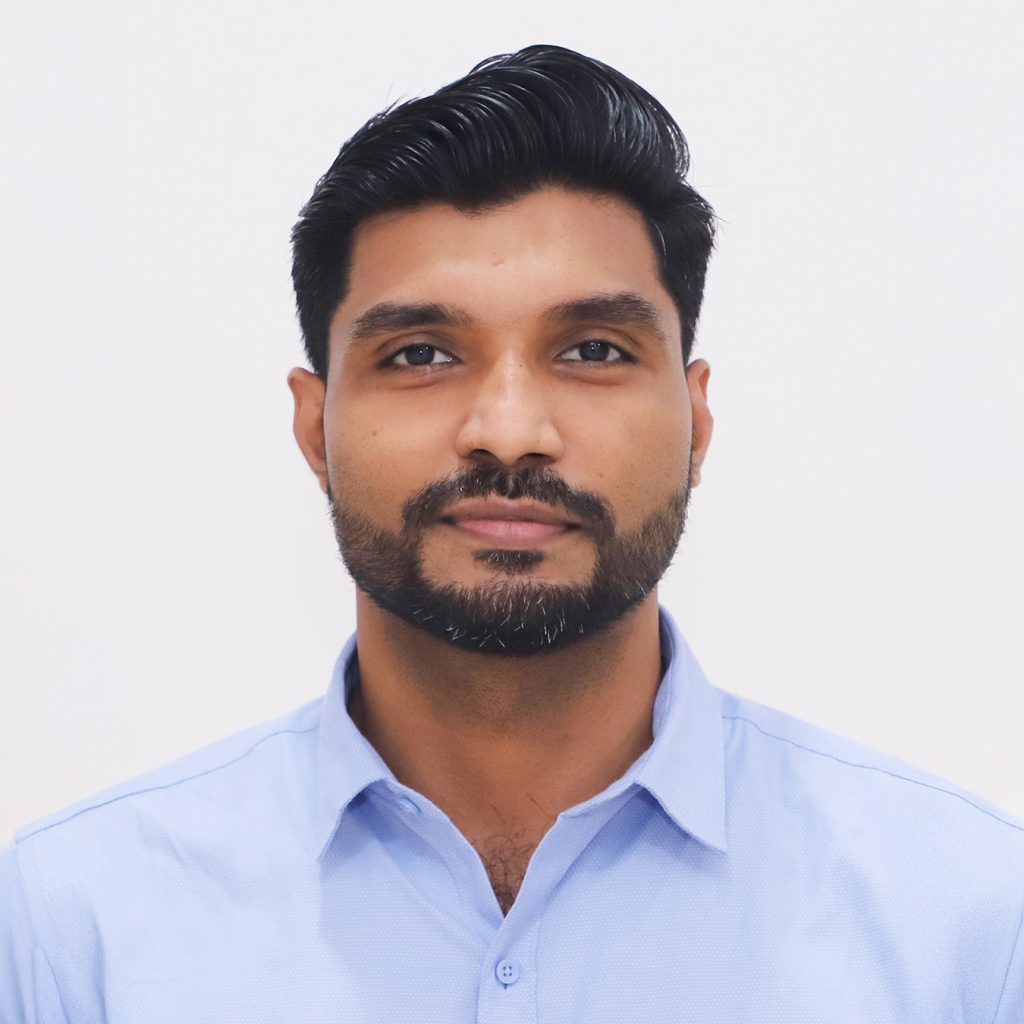
Dr. Suvanish Kumar
Assistant Professor
Profile
• His professional experience spans academia and industry. He served as an Assistant Professor at the SAFI Institute of Advanced Study (Autonomous, University of Calicut) prior to joining BMT-SCTIMST as a Scientist-B (funded by DBT), where his research centered on the development of 3D-printed biological epidermis.
• Dr. Kumar served as a Research Scientist at Accubits Invent Pvt. Ltd. for three years, leading projects in genetic engineering, nanotechnology, and bioinformatics.
Educational Qualifications
• PhD – National Institute of Technology, Calicut | Kozhikode, India | (2018)
• MSc in Biotechnology – Cochin University of Science and Technology (CUSAT) | Kochi, India | (2012)
• BSc in Biotechnology – Mahatma Gandhi University | Kottayam, India | (2010)
Professional Experience (Research/Training/Industry)
• Assistant Professor – Chinmaya Vishwa Vidyapeeth, Kerala | 2024 – Present
• Research Scientist & Manager – Accubits Invent Pvt. Ltd., Kerala | 2021 – 2024
• Scientist-B – BMT-SCTIMST, Kerala | 2019
• Assistant Professor – SAFI Institute of Advanced Studies (Autonomous), Kerala | 2017 – 2019
• Junior Research Fellow (ICMR) – National Institute of Technology, Calicut, Kerala | 2012 – 2015
Awards & Achievements
Awards & Recognitions
• Scientist-B Fellowship, Department of Biotechnology (DBT), Govt. of India | (2019)
• Junior Research Fellowship (JRF), Indian Council of Medical Research (ICMR) | (2012)
Publications
International Journals (13)
• VS Suvanish Kumar and N. Sreekumar. “Bioinformatic Resources for Plant Genomic Research.” Current Bioinformatics 19.6 (2024): 513–529.
• Vyshnavi, H., et al. “Homology Modeling and Evaluation of Sars-Cov-2 Spike Protein Mutant: D614G.” Research Anthology on Bioinformatics, Genomics, and Computational Biology (2024).
• Somasekharan, Lakshmi T., et al. “Biofabrication of Skin Tissue Constructs Using Alginate, Gelatin and Diethylaminoethyl Cellulose Bioink.” International Journal of Biological Macromolecules 189 (2021): 398–409.
• Naisam, S., V. S. Viji, Suvanish Kumar, and N. Sreekumar. “In-Silico Analysis to Identify Potent Quinoline Analogues Against Multi-Targets of SARS-CoV-2.” International Journal of Quantitative Structure-Property Relationships 6.3 (2021).
• Naisam, S., V. S. Vidhya, Suvanish Kumar, and N. Sreekumar. “Virtual Screening of Phyto Chemicals Against SARS-CoV-2 Targets: Spike, RdRp, and Proteases.” International Journal of Quantitative Structure-Property Relationships 6.3 (2021).
• Mathavan, S., and Suvanish Kumar. “Evaluation of the Effect of D614G, N501Y and S477N Mutation in SARS-CoV-2 Through Computational Approach.” International Journal of Quantitative Structure-Property Relationships 5.3 (2020).
• Suvanish Kumar, V. S., Etheresia Pretorius, and G. K. Rajanikant. “The Synergistic Combination of Everolimus and Paroxetine Exerts Post-Ischemic Neuroprotection In Vitro.” Cellular and Molecular Neurobiology 38.7 (2018): 1383–1397.
• Sinoy, S., et al. “Amikacin Inhibits miR-497 Maturation and Exerts Post-Ischemic Neuroprotection.” Molecular Neurobiology 54.5 (2017): 3683–3694.
• Fayaz, S. M., V. S. Suvanish Kumar, C. K. Davis, and G. K. Rajanikant. “Novel RIPK3 Inhibitors Discovered Through a Structure-Based Approach Exert Post-Ischemic Neuroprotection.” Molecular Diversity 20.3 (2016): 719–728.
• Venugopal, V., et al. “Biochemical Characterization of Liver Oil of Echinorhinus Brucus (Bramble Shark) and Its Cytotoxic Evaluation on Neuroblastoma Cell Lines (SHSY-5Y).” Scientifica 2016 (2016): 6294030.
• Fayaz, Shaik M., V. S. Suvanish Kumar, and K. G. Rajanikant. “Finding Needles in a Haystack: Application of Network Analysis and Target Enrichment Studies for the Identification of Potential Anti-Diabetic Phytochemicals.” PLoS One 9.11 (2014): e112911.
• Fayaz, S. M., V. S. Suvanish Kumar, and G. K. Rajanikant. “Necroptosis: Who Knew There Were So Many Interesting Ways to Die?” CNS & Neurological Disorders–Drug Targets 13.1 (2014): 42–51.
• Suvanish Kumar, V. S., A. Gopalakrishnan, M. Naziroglu, and G. K. Rajanikant. “Calcium Ion – The Key Player in Cerebral Ischemia.” Current Medicinal Chemistry 21.18 (2014): 2065–2075.
National Journals (1)
• Radhakrishnan, S., et al. “Performance & Clinical Utility of Oropharyngeal Versus Nasopharyngeal Swabs in COVID-19.” Indian Journal of Medical Research 156.3 (2022): 478–483.
Book Chapters
• Nil
Books Published
• Nil
Membership/Positions in Professional Bodies
Membership/Positions in Professional Bodies
Presentations
Conferences and Academic Engagements
• International Conferences: Nil
• National Conferences: Nil
• Keynote/Guest/Academic Lectures/Sessions: Nil
• Guest Lectures: Nil
Workshops & Certifications
Training Programs & Workshops
• Training Program on CRISPR/Cas9 Gene Editing Technologies organized by ICRISAT, Hyderabad (2022)
• Workshop on Basic Biomethodology of Laboratory Mice and Rats organized by NCBS, Bangalore (2019)
• Training Workshop on FACS, Cytoflex organized by BD BioSciences (2012)
FDP
• Smart Energy Storage Technologies: From Research to Real-World Applications – Government College of Engineering Kannur ATAL FDP (16–22 Dec 2025)
• Renewable Energy Systems and Grid Integration: Technologies, Challenges & Solutions – MEA Engineering College, Perinthalmanna ATAL FDP (1–6 Dec 2025)
• Engineered Materials for Multidisciplinary Applications – Chinmaya Vishwavidyapeeth ATAL FDP (17–25 Feb 2025)
Faculty Engagements
Research Projects And Activities
Research Projects
• 3D-Printed Biological Skin (Scientist-B), BMT-SCTIMST | (2019–2020)