
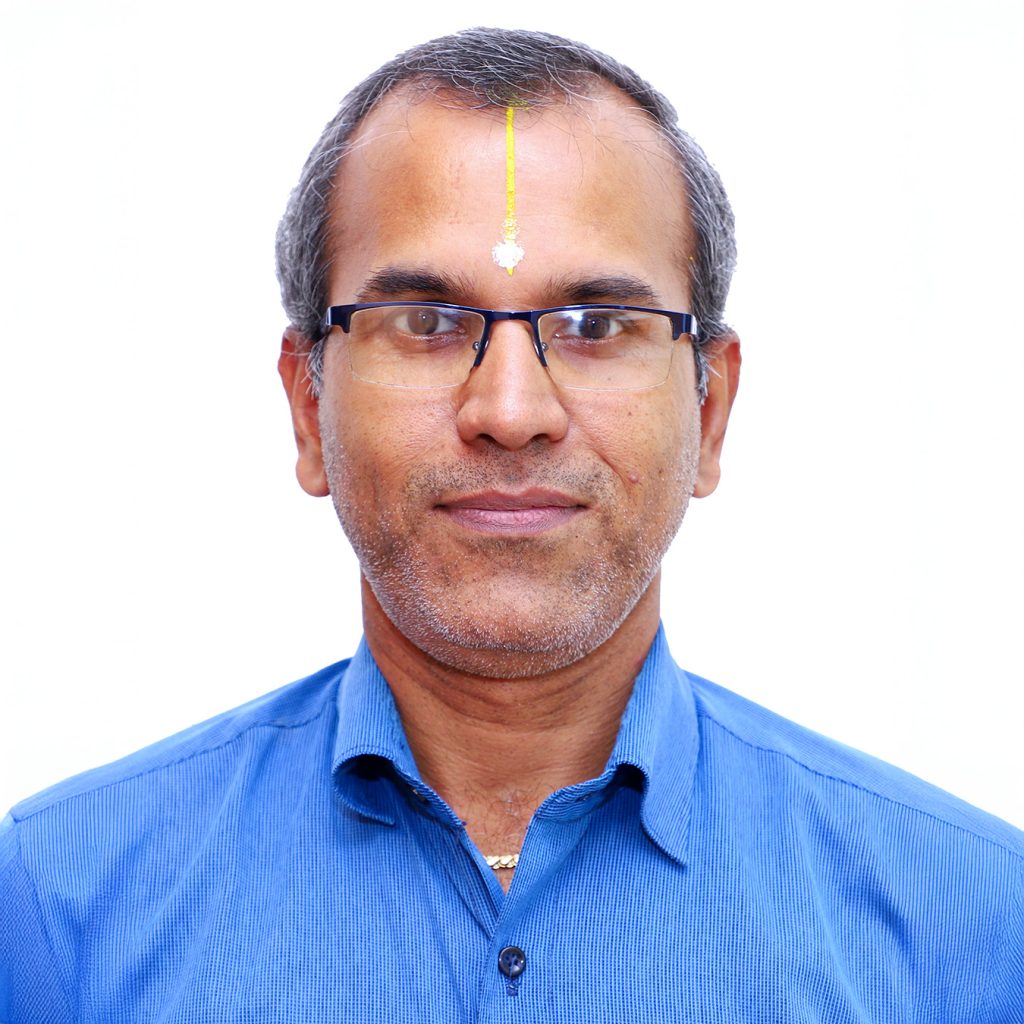
Dr. L. Sampath Kumar
Associate Professor
Dr. L. Sampath Kumar is an Associate Professor and Head of the School of Linguistics and Literary Studies. Doctorate in “Abhidhānaratnamālā – A Study” from Pondicherry University. Author and editor of eight books. Presented research papers at international and national seminars. Proficient in Sanskrit, English, Tamil, and Hindi. Poet in all four languages; Sanskrit lyricist for two dance-dramas. Recipient of the “Acharya Ratna” Award by Sri Siva Swamy Kalalaya Education Society, Chennai (2017)
Educational Qualifications
• BEd, Indira Gandhi National Open University, New Delhi (2012)
• PhD in Lexicography, Pondicherry University (2000)
• MPhil in Critical Edition, University of Madras (1994)
• UGC-NET, University Grants Commission (1994)
• MA, University of Madras (1993) – University First Rank with Three Gold Medals
• BA, University of Madras (1991) – University First Rank
Professional Experience (Research/Training/Industry)
• Associate Professor, Chinmaya Vishwa Vidyapeeth, Ernakulam (Nov 2018 – Present)
• Assistant Professor, DG Vaishnav College, Chennai (July 2009 – October 2018)
• Assistant Professor (Part-time), Sri Ahobila Math Adarsha Sanskrit College, Madurantakam (January 2003 – March 2005)
• Assistant Professor, DG Vaishnav College, Chennai (July 2001 – December 2003)
• Guest Lecturer, Presidency College, Chennai (August 2000 – March 2002)
Awards & Achievements
Awards & Recognitions
• “Best Paper Award” for the paper “COVID-19 and Economic Stimulus Packages: Lessons from Indian History” at the International Conference “Challenges and Prospects in Management in the VUCA World”, Symbiosis Institute of Business Management, Nagpur.
• Acharya Ratna Award (2017).
• Won Three Gold Medals in MA (1993).
• University First Rank Holder in BA (1991).
Chair/Co-Chair of Academic Technical Sessions (2)
• Kumar, L. S. (2024, February 2–4). Kerala’s Contribution to Vedānta. Session chaired at National Academic Programme organized by CVV, CIF, and ICPR, CIF.
• Kumar, L. S. (2023, June 30–July 2). Yoga as an Embodied Culture of Bhārata. Session chaired at National Academic Programme, CIF.
Publications
International Journals (3)
• Kumar, L. S. (2025). Utility of Kośa-s in Understanding Sanskrit Literature. Sanskrit Vimarsah E-Journal, 25, 377–387. [UGC-CARE]
• Jayanthi, S. V., Kumar, L. S., & Mohan, A. (2022). COVID-19 and Economic Stimulus Packages: Lessons from Indian History. Journal of International Business and Economy, 23(1), 87–103. [UGC-CARE]
• Kumar, L. S. (2021). Varadaraja Pañcāśatyavatāravarṇanam. Sanskrit Vimarsah E-Journal, 20, 44–48. [UGC-CARE]
National Journals (15)
• Kumar, L. S. (2025). Utility of Kośa-s in Understanding Sanskrit Literature. Sanskrit Vimarsah E-Journal, 25.
• Anusha, S., Srinivas, A., & Kumar, L. S. (2024). Assessment in Anganwadis. Hitaya, 20.
• Ezhilvannan & Kumar, L. S. (2023). Value Education Based on Indic Knowledge Systems: Analysis of the Rāmāyaṇa Content in Tamil Nadu State Board Textbooks. Dhimahi, 14, 255–267.
• Anusha, S., Srinivas, A., & Kumar, L. S. (2023). Fun Element in Teaching–Learning at Anganwadis. Global Multidisciplinary Research Journal, 7(2), 77–87.
• Kannan, R., Varma, S., & Kumar, L. S. (2023). Action and Outcome Correlation: Including the Gita Mindset in Students. Dhimahi, 13, 15–26.
• Seth, N., & Kumar, L. S. (2023). Use of Tatrayuktis: An Ancient Indic System for Research Methodology in Carakasaṁhitā. Prācyā, 15(Part I), 89–105.
• Kumar, L. S., Jayanthi, S. V., & Pandit, S. (2023). Suicide and Its Prevention: Insights from Vālmīki Rāmāyaṇa. Journal of Oriental Research, 98, 219–234.
• Panchal, D. N., & Kumar, L. S. (2022). Position of Water in Select Purāṇas. Shodhasamhita, 9(2).
• Kumar, L. S. (2021). Reflection of Bhagavad Gita on Tirukkural. Samskrita Academy 90th Anniversary Commemoration Volume.
• Kumar, L. S. (2020). Awareness of Health in Sanskrit Literature. Ajanta, 87–93.
• Kumar, L. S. (2020). Tirukkural Granthe Dharmavichāraḥ. Dhimahi, 121–127.
• Kumar, L. S. (2019). Kamparāmāyaṇe Raghuvaṁśa Mahākāvyasya Prabhāvaḥ. Rasikapriya, 33–36.
• Kumar, L. S. (2019). Buddhodayakāvya of Śāntibhikṣu—An Analysis. Prācyā, 76–85.
• Kumar, L. S. (2017). Kapilopadeśe Bhaktimārgaprabhāvaḥ. Rasikapriya.
• Kumar, L. S. (2004). Dukūla—A Study. Knowledge Economy, 51–52.
Book Chapters (3)
• Kumar, L. S. (2023). Effectiveness of Teaching through Non-Formal Systems—Case Studies from Ancient Indian Literature. In Hybrid Learning: Preparing Tomorrow’s Solution. CVV.
• Kumar, L. S., & Nanda, H. (2022). Music and Nature. In Saṅgīta Sañcintanam – Reflections on Art and Artistry (pp. 77–87). Chinmaya International Foundation.
• Kumar, L. S. (2022). Significance of Śrī. In Ādi Śakti – Philosophy and Narratives of the Feminine Divine (pp. 30–39). Chinmaya International Foundation.
Books Published (10)
• Kumar, L. S. (2017). Padaippu: Srishti Vijnanam. Sri Sri Publications Trust.
• Sowmyanarayanan, V., & Kumar, L. S. (2017). Complete Works of Śrīmad Rāmānuja. Srimad Andavan Ashram.
• Kumar, L. S. (2017). Ādiśeṣaḥ: A Sanskrit Translation. Srirangam.
• Kumar, L. S. (2009). Kishor Satsang. Swami Narayan Aksharpith.
• Kumar, L. S. (2008). Ganshyam Charitra. Swami Narayan Aksharpith.
• Kumar, L. S. (2008). Akshar Brahma Gunatitananda Swami. Swami Narayan Aksharpith.
• Kumar, L. S. (2006). Brahmaswarup Yogiji Maharaj. Swami Narayan Aksharpith.
• Kumar, L. S. (2006). Bhagavan Swami Narayan. Swami Narayan Aksharpith.
• Kumar, L. S. (2005). Idayanadam: Tamil Translation of “Vibrations”. Swami Narayan Aksharpith.
• Kumar, L. S. (2004). Sikshapatriyin Muthukkal: Tamil Translation of “Gems from Sikshapatri”. Swami Narayan Aksharpith.
Membership/Positions in Professional Bodies
Membership/Positions in Professional Bodies
• Member, PhD Adjudication, University of Madras.
• Member, Question Paper Setting, The Presidency College, Chennai.
Membership/Positions in Professional Bodies
Presentations
International Conferences (10)
• Kumar, L. S. (2023, April 4). Anaṅgatilakabhāṇa: An unpublished manuscript. International Seminar, Sri Sri University, Cuttack (Online).
• Kumar, L. S. (2023, March 17). Using IKS Stories in Providing Indian Content in Management Curriculum. International Conference, Chanakya University, Bangalore (Hybrid).
• Kumar, L. S. (2022, May 7). Effectiveness of Teaching through Non-Formal Systems: Case Studies from Ancient Indian Literature. International Conference, CVV (Hybrid).
• Kumar, L. S. (2021, February 17). COVID-19 and Economic Stimulus Packages: Lessons from Indian History. International Conference, Symbiosis Institute of Business Management, Nagpur (Online).
• Kumar, L. S. (2019, December 17). Puruṣārtha Perspectives vis-à-vis the Tirukkuṛaḷ and the Gītā. International Conference, CVV (Published in Proceedings).
• Kumar, L. S. (2016, August 13). Kamban and Tulasidasa: A Comparison. 42nd Kamban Vizha, Kamban Kazhagam, Chennai.
• Kumar, L. S. (2005, November 6). Bhakti Anubhava of Thirumazhisai Azhvar. International Seminar on World Tamil Literature, Dr. M.G.R. Janaki Women’s College, Chennai.
• Kumar, L. S. (2005, March 23). Rare Words in Vālmīki Rāmāyaṇa. International Conference on Indian Lexicography, University of Madras.
• Kumar, L. S. (1997, January). Inscriptional Words in Amarakośa and Abhidhāna Ratnamālā. X World Sanskrit Conference, Rashtriya Samskrit Sansthan, Bangalore.
National Conferences (17)
• Kumar, L. S. (2025, September 27). Subraḥmaṇya-Bhujaṅga-Stotram of Ādi Śaṅkarācārya. National Seminar, Vishnu Mohan Foundation, Chennai.
• Kumar, L. S. (2023, October). Balancing Material and Spiritual Pursuits. National Seminar on Bhagavad Gita, Thoduppuzha, Kerala.
• Kumar, L. S. (2023). Introduction to IKS. Scientific Bharat, Azadi Ka Amrit Mahotsav.
• Kumar, L. S. (2020, July 10). Health Awareness in Sanskrit Literature. Mahatma Jyotiba Phule Mahavidyalaya, Nanded.
• Kumar, L. S. (2019, September 16). Prapatti in Nyāsavimśati. Conference on Oneness, Indic Academy & CVV, Kochi.
• Kumar, L. S. (2019, September 13). Suicide Prevention from Rāmāyaṇa. Sevabharathi Punarjani Counselling Centre, Kochi.
• Kumar, L. S. (2019, February 16–17). Influence of Raghuvaṁśa on Kamba Rāmāyaṇa. Madras Sanskrit College, Chennai.
• Kumar, L. S. (2019, May 4–5). Comparative Study of Rāmāyaṇas. Sri Vishnu Mohan Foundation, Chennai.
• Kumar, L. S. (2018, December 5). Varadarājapañcāśati Avatāravarṇanam. Sri Ahobila Mutt, Madurantakam.
• Kumar, L. S. (2017, March 28). Life of Rāmānuja. Presidency College, Chennai.
• Kumar, L. S. (2015, March 7). Tirukkural Granthe Dharmaḥ. Rashtriya Samskrita Vidyapeeth, Tirupati.
• Kumar, L. S. (2015, March 3). Heroines of Kālidāsa. Queen Mary’s College, Chennai.
• Kumar, L. S. (2012, March 2). Democracy in Mahābhārata. D.G. Vaishnav College, Chennai.
• Kumar, L. S. (2006, July 23). Tamil Meghasandeśa. Dr. M.G.R. Janaki Women’s College, Chennai.
• Kumar, L. S. (1999, March 20). Architecture in Abhidhāna Ratnamālā. R.K.M. Vivekananda College, Chennai.
• Kumar, L. S. (1998, December 12). Indian Dressing Style in Abhidhāna Ratnamālā. R.K.M. Vivekananda College, Chennai.
• Kumar, L. S. (1996, March 14). Inscriptional Words in Abhidhāna Ratnamālā. R.K.M. Vivekananda College, Chennai.
Keynote (2)
• Exploring Indian Knowledge Systems: Domains and Significance. FDP on IKS with TK & IPR, IGNCA, Ministry of Culture, New Delhi (March 2024).
• Ramayana Traditions. Kamba Ramayana Lecture Series, Kelir Ilakkiya Murram (July 2021).
Guest Lectures (27)
• Rasānubhūti through Movies – CIF (Jan 2026).
• What is IKS? – Nanda Ayurveda College (Dec 2025).
• Physics in Sanskrit – Central Sanskrit University, Guruvayoor (Nov 2025).
• Understanding IKS – Central Sanskrit University, Guruvayoor (Oct 2025).
• Need for Sanskrit – NIT Calicut (Sept 2025).
• Nāṭyaśāstra – Indic Fest, Chinmaya Mission, Kolkata (Aug 2025).
• Ethics & Dharma in Sanskrit Literature – National Sanskrit University, Tirupati (Oct 2024).
• Psychological Aspects in Vālmīki Rāmāyaṇa – SLSNSU, New Delhi (Sept 2024).
• Choosing IKS Topics – BSSEI (Sept 2024).
• Aiṅkur̥unūr̥u Translation – Tamil University (Aug 2024).
• Utility of Kośas – CIFSS, Ernakulam (Jan 2024).
• Gītā – National Conference, Thoduppuzha (Oct 2023).
• Revitalising Sanskrit Knowledge – CiFSS, Ernakulam (Mar 2023).
• Introduction to IKS – Scientific Bharat (Oct 2022).
• Dūtākāvyas – CIF Ernakulam (Jul 2022).
• Amarakośa Applications – Tiruchirappalli (Oct 2021).
• Bhāsa Plays – DGV College (Oct 2021).
• Rāmāyaṇa Traditions – Kelir Ilakkiya Murram (Jul 2021).
• Viṣṇupurāṇa – CVV (May 2021).
• Śrī Ādiśakti – CVV (Nov 2020).
• Rāmāyaṇa Psychology – Sevabharati Kochi (Aug 2020).
• Kaṭapayādi Saṅkhyā – CVV (Aug 2020).
• Sanskrit Blueprint – CVV (Aug 2020).
• Contribution of Kureśa – Kuppuswami Sastri Institute (Aug 2020).
• Bhāsa Plays – Shasun Jain College (Jul 2020).
• Nārāyaṇatattva – CVV (Jul 2020).
Workshops & Certifications
Workshops Attended
• Workshop on “Enhancing the Quality of Education by PO–CO Mapping as per NAAC Standards”, CVV (March 2020).
• National Level Online Workshop on “SMART Research – Phase 1”, organised by IQAC Cell, Government First Grade College, Kanakapura (May 2020).
• Online Workshop on “Scientific Writing for Journals”, organised by Springer Nature (May 2020).
• Online National Workshop on “Design & Develop: Audio and Video e-Resources”, organised by Teaching Learning Centre, Shri Lal Bahadur Shastri National Sanskrit University, New Delhi (May 2020).
Faculty Engagements
FDP
• Generative AI and Tools for Academic Research, organised by Scrollwell (November 2024).
Certificate Courses Attended
• Arthasastra: A Comprehensive Overview, organised by Vyoma Linguistics Labs Foundation (September 2025).
Public Engagements
• Conducted “Spoken Sanskrit” in Tripunithura for the public.
Other Engagements
• NA
Major Academic/Administrative Roles/Positions Held at CVV
• Head of LLS (till December 2025).
• Member, Academic Council, CVV.
• Chair, BoS, CVV.
Research Projects And Activities
Research Projects
• Ainkurunuru – Translation, Sponsored by the Central Institute of Classical Tamil (2023)
• Sanskrit Lexicon for Neurology, Sponsored by AICTE (2023)
Ph.D. Supervision
• Ramya Kannan – A Study of Bhagavad Gītā | 2019 – Awarded
• Ezhilvannan – Value Education in Vālmīki Rāmāyaṇa | 2019 – Ongoing
• Disha Nithin Panchal – Multi-dimensional Aspects of Water in Purāṇas | 2019 – Ongoing
• Neeraja Sheth – Duḥkhanivṛtti – With Special Reference to Parental Sorrow | 2021 – Ongoing
• Ruchita Rane – A Study of Minor Millets | 2022
• Manju Mohan – Subanta Generator | 2022
• A. P. Nandini – Rukmiṇīpariṇaya – A Critical Edition and Study | 2025