
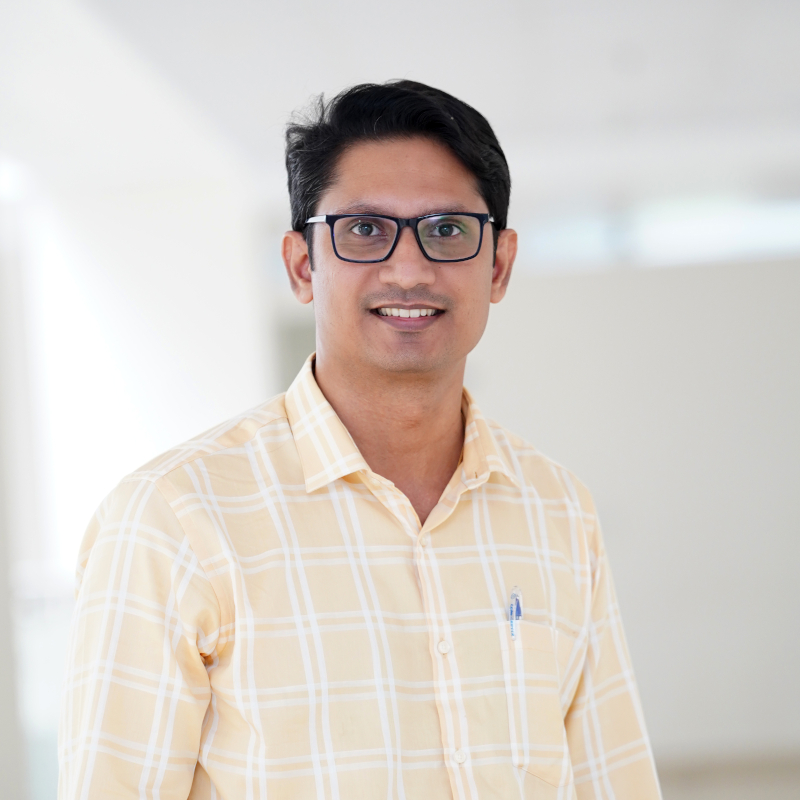
Dr. Sreehari H.
Assistant Professor | STEM-ECE
Assistant Professor in Electronics and Communication Engineering specialized in Astronomy and Machine Learning applications for research. I work on observational data of astrophysical black hole systems and study their Fourier spectra, energy spectra, and time series evolution. I also use simulations to understand extreme lensing by astrophysical sources and use correlations and convolutional neural networks (CNNs) to estimate source parameters. My areas of interest include Electromagnetics, Antenna Theory, and Signals and Systems.
Education
-
-
- PhD (Astronomy & Astrophysics)
Indian Institute of Science, Bangalore | 2019 - MTech (Electronics and Communication Engineering)
Specialization: Microwave Engineering
College of Engineering Trivandrum | 2012 - BTech (Electronics and Communication Engineering)
Government Engineering College, Barton Hill, Trivandrum | 2008 - XII
St Thomas Central School, Trivandrum | 2004 - X
St Thomas High School, Trivandrum | 2002
- PhD (Astronomy & Astrophysics)
-
Professional Experience
-
-
- Assistant Professor (STEM-ECE)
Chinmaya Vishwa Vidyapeeth, Kerala | Sep 2026 – Present - Visiting Researcher
IIST Trivandrum | May 2026 – Aug 2026 - Postdoctoral Fellow
University of Haifa, Israel | Nov 2022 – Sep 2025 - Postdoctoral Fellow
Indian Institute of Astrophysics, Bangalore | Jun 2020 – Nov 2022 - Associate Software Engineer
Accenture Services Pvt Ltd, Chennai | Aug 2008 – Oct 2009
- Assistant Professor (STEM-ECE)
-
Awards & Achievements
Publications
International Journal Publications: 15
-
- Sreehari Harikesh, Shahar Hadar, Doron Chelouche, “Exploring lensing signatures through spectrotemporal correlations: implications for black hole parameter estimation”, Physical Review D (ISSN 2470-0029, Impact Factor 5.3, Q1),112, 043020, 14 August 2025, https://doi.org/10.1103/wjpm-9byt
- Sreehari Harikesh, Seshadri Majumder, Santabrata Das, Anuj Nandi, “Evidence for ‘compact’ oscillating Comptonized corona in GRS 1915+105: Tracing the HFQPOs with AstroSat”, MNRAS 540-4, (Impact Factor 4.8, Q1) 6 June 2025, p2965-2974, https://doi.org/10.1093/mnras/staf926
- Indrani Pal, Anju A, H. Sreehari, Gitika Rameshan, C. S. Stalin, Claudio Ricci, S. Marchesi, “On the properties of X-ray corona in Seyfert 1 galaxies”, ApJ (ISSN: 1538- 4357, Impact Factor 5.4, Q1),976:145 (23pp), 19 November 2024, https://doi.org/10.3847/1538-4357/ad8088
- Shahar Hadar, Sreehari Harikesh, Doron Chelouche, “Extreme lensing induces spectrotemporal correlations in black-hole signals”, Physical Review D (ISSN 2470- 0029, Impact Factor 5.3, Q1), 29 June 2023, 107, 124057, https://doi.org/10.1103/PhysRevD.107.124057
- Seshadri Majumder, H. Sreehari, Nafisa Aftab, Tilak Katoch, Santabrata Das, Anuj Nandi, “Wide-band view of High-Frequency QPOs of GRS 1915+105 in ‘softer’ variability classes observed with AstroSat”, MNRAS (ISSN 1365-2966, Impact Factor 5.287, Q1), 29 March 2022, 512-2, 2508–2524, https://doi.org/10.1093/mnras/stac615
- H. Sreehari & Anuj Nandi, “A Machine Learning approach for classification of accretion states of Black hole binaries”, MNRAS (ISSN 1365-2966, Impact Factor 5.287, Q1), 20 Jan 2021, 502-1, 1334-1343, https://doi.org/10.1093/mnras/stab151
- H. Sreehari, Anuj Nandi, Santabrata Das, V. K. Agrawal, Samir Mandal, M. C. Ramadevi, Tilak Katoch, “AstroSat view of GRS 1915+105 during the Soft State: Detection of HFQPOs and estimation of Mass and Spin”, MNRAS (ISSN 1365-2966, Impact Factor 5.287, Q1), 13 October 2020, 499-4, 5891–5901, https://doi.org/10.1093/mnras/staa3135
- H. Sreehari; Ravishankar B. T.; Nirmal Iyer; V. K. Agrawal; Tilak B. Katoch; Samir Mandal; Anuj Nandi; “AstroSat view of MAXI J1535-571: broadband spectro temporal features”, MNRAS (ISSN 1365-2966, Impact Factor 5.287, Q1), 14 May 2019, 487-1, 928-941, https://doi.org/10.1093/mnras/stz1327
- H. Sreehari; Radhika, D.; Nandi, Anuj; Iyer, Nirmal; Mandal, Samir; “Constraining the mass of black hole candidate GX 339-4 using spectro-temporal analysis of multiple outbursts”, Advances in Space Research (ISSN 0273-1177, Impact Factor 2.8, Q2), 1 February 2019, 63-3, 1374-1386, https://doi.org/10.1016/j.asr.2018.10.042
- Aneesha U., Samir Mandal, H. Sreehari, “Study of the long-term evolution of the accretion dynamics of GX 339−4”, MNRAS (ISSN 1365-2966, Impact Factor 5.287, Q1), 25 April 2019, 486, 2, p.2705-2720, https://doi.org/10.1093/mnras/stz1000
- H. Sreehari; Nandi, Anuj; Radhika, D.;Iyer, Nirmal; Mandal, Samir; “Observational aspects of outbursting black hole sources: Evolution of spectro-temporal features and X-ray variability”, Journal of Astrophysics and Astronomy (ISSN 0973-7758, Impact Factor 1.6, Q3), 9 February 2018, 39-5, https://doi.org/10.1007/s12036-018-9510-0
- Radhika D.; H. Sreehari; Nandi, Anuj; Iyer, Nirmal; Mandal, Samir; “Broad-band spectral evolution and temporal variability of IGR J17091-3624 during its 2016 outburst: Swift and NuSTAR results”, Astrophysics and Space Science (ISSN 1572- 946X, Impact Factor 1.830, Q3), 21 August 2018, 363-189, https://doi.org/10.1007/s10509-018-3411-1
- Nandi, Anuj; Mandal, Samir; H. Sreehari; Radhika, D.; Das, Santabrata; Chattopadhyay, I.; Iyer, Nirmal; Agrawal, V. K.; Aktar, Ramiz; “Accretion flow dynamics during 1999 outburst of XTE J1859+226 – modelling of broadband spectra and constraining the source mass”, Astrophysics and Space Science (ISSN 1572-946X, Impact Factor 1.830, Q3), 9 April 2018, 363-90, https://doi.org/10.1007/s10509-018- 3314-1
- Aktar, Ramiz; Das, Santabrata; Nandi, Anuj; H. Sreehari, “Advective accretion flow properties around rotating black holes – application to GRO J1655-40”, Journal of Astrophysics and Astronomy (ISSN 0973-7758, Impact Factor 1.6,Q3), 10 February 2018, 39-17, https://doi.org/10.1007/s12036-017-9507-0
- Aktar, Ramiz; Das, Santabrata; Nandi, Anuj; H. Sreehari, “Estimation of mass outflow rates from dissipative accretion disc around rotating black holes”, MNRAS (ISSN 1365-2966, Impact Factor 5.287, Q1), 26 July 2017 471-4, p.4806-4819, https://doi.org/10.1093/mnras/stx1893
Conference Publications: 4
-
- Majumder, Seshadri ; H. Sreehari ; Aftab, Nafisa ; Katoch, Tilak ; Das, Santabrata ; Nandi, Anuj, “A deeper insight into the HFQPOs of GRS 1915+105 with AstroSat”, 44th COSPAR Scientific Assembly. Held 16-24 July, 2022. https://www.cosparathens2022.org/. Abstract E1.5-0028-22
- H. Sreehari; Iyer, Nirmal; Nandi, Anuj; “Constraining the mass of Galactic black hole GX 339-4”, ASI Conference Series, 2015, 12, pp 123 – 124, https://www.astron soc.in/bulletin/asics vol012
- Vijayakumar Narayanan; H. Sreehari; S Sreedevi Nair, “Temperature resilient measurement of refractive index for liquids”, 2013 Seventh International Conference on Sensing Technology (ICST), 2013, New Zealand, Electronic ISSN: 2156-8073 doi:10.1109/ICSensT.2013.6727677
- H. Sreehari; S. Shabu, “A Meandered structure for miniaturizing the Planar Inverted F antenna”, NCTT, 6 November 2012, Trivandrum.
Membership/Positions in Professional Bodies
Membership/Positions in Professional Bodies
Presentations
TALKS
-
- Finding Black holes: From X-rays to Gravitational Waves. 14th IIST Astronomy and Astrophysics School 2026 (IAAS-2026), 2026 July 20.
- Extreme lensing induced X-ray correlations: Estimation of black hole parameters, RETCO VI, IIT Indore, 2025 Mar 10-12.
- X-ray correlations due to extreme lensing by black holes, High Energy Astrophysics and Cosmology in the era of all-sky surveys, Yerevan, Armenia, 2024 Oct 7-11.
- ILASOL, Technion, Israel, 2024 June 3.
- Probing the accretion of material onto black holes using space observatories, DSRC Poster, University of Haifa, Israel, 2023 May 22.
- Black holes from theory to observations, Academic Conference, Israel Space Week, Tel Aviv, Israel, 2023 Feb 01.
- Broad band SED modelling of blazars observed with AstroSat, 44th COSPAR Scientific Assembly, p2251, 2022 July 16.
- A deeper insight into the HFQPOs of GRS 1915+105 with AstroSat, 44th COSPAR Scientific Assembly, p2241, 2022 July 16.
- Machine Learning Techniques: New Approach of Compact Object Studies, Exploring The Saga of Compact Objects (ESCO), 2021 Sep 11.
- Clustering techniques in X-ray Astronomy, IIA, Bangalore, 2021 Sep 09. • Observational Aspects of Black Hole Binaries, IIA Bangalore, 2020 Jul 28.
- Observational Aspects of Black Hole Binaries, IIT Guwahati, 2020 Feb 18.
- Spectro-temporal Analysis of 1E 1740.7-2942 with AstroSat data, AstroSat Science Meet’, ISRO HQ, Bangalore., 2017.
- Constraining the mass of GX 339-4 using multiple outburst data with spectro-temporal techniques, RETCO III, IIST, Thiruvananthapuram, 2017.
- Constraining the mass of Galactic black hole GX 339-4, BASI, Vol. 12, pp 123 – 124., 2015.
- Moons of the Solar System, University Visvesvaraya College of Engineering, Bangalore., 2013.
- Temperature resilient measurement of refractive index for liquids, ICST, New Zealand, 2013.
- A Meandered structure for miniaturizing the Planar Inverted F antenna, NCTT, Trivandrum, 2012.
Reviewer for International Journals
Monthly Notices of the Royal Astronomical Society (MNRAS)
Workshops & Certifications
Additional Courses
Big Data and Machine Learning Pro Degree (2019) from Imarticus Learning in collaboration with IBM.
Workshops
-
- High-Energy X-ray Instrumentation: From AstroSat Science to Next-Generation Payload Design, IIST Trivandrum, June 4–5, 2026
- Data Science Summer school Data Science Research Center (DSRC), University of Haifa, Israel with NVIDIA, September 4-13, 2023.
- Is-Ko-Space 2023, Israeli-Korean Astronomy & Space Science workshop, Ariel University, Israel, Jan 29, 2023
- Summer school in Astroinformatics, Pennsylvania State University, June 13-17, 2022,
- Summer school in Astrostatistics, Pennsylvania State University, June 6-10, 2022,
- Growth Astronomy School, California Institute of Technology, 2020 • Transient Astronomy ISITE, URSC, ISRO, Bangalore, 2019
- Astrostatistics Workshop IUCAA, Pune, 2016
- Numerical Relativity School ICTS, Bangalore, 2013