
Three-day International Conference on ‘Spirituality, Education and Patriotism: Contribution of Swami Chinmayananda and Beyond’
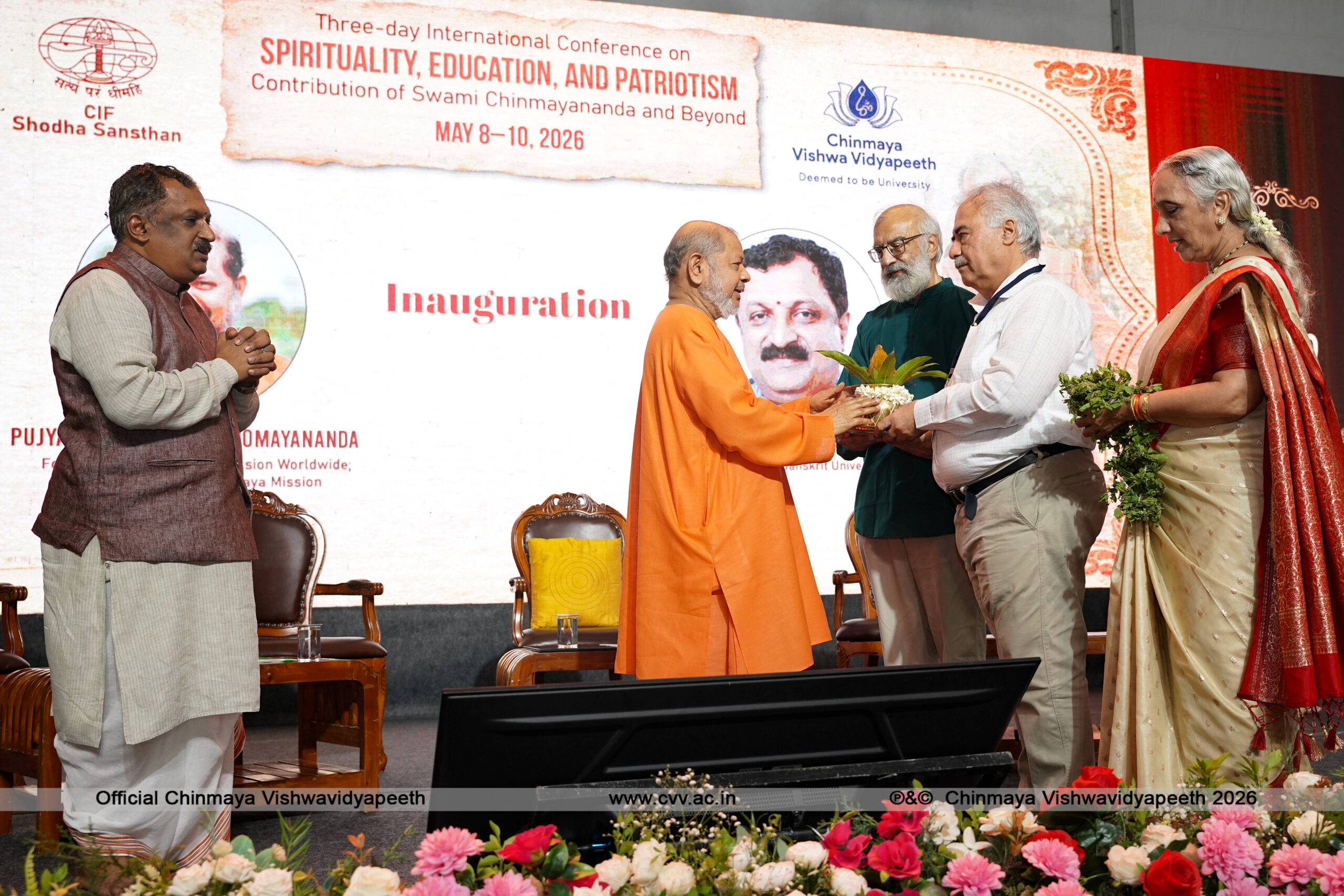
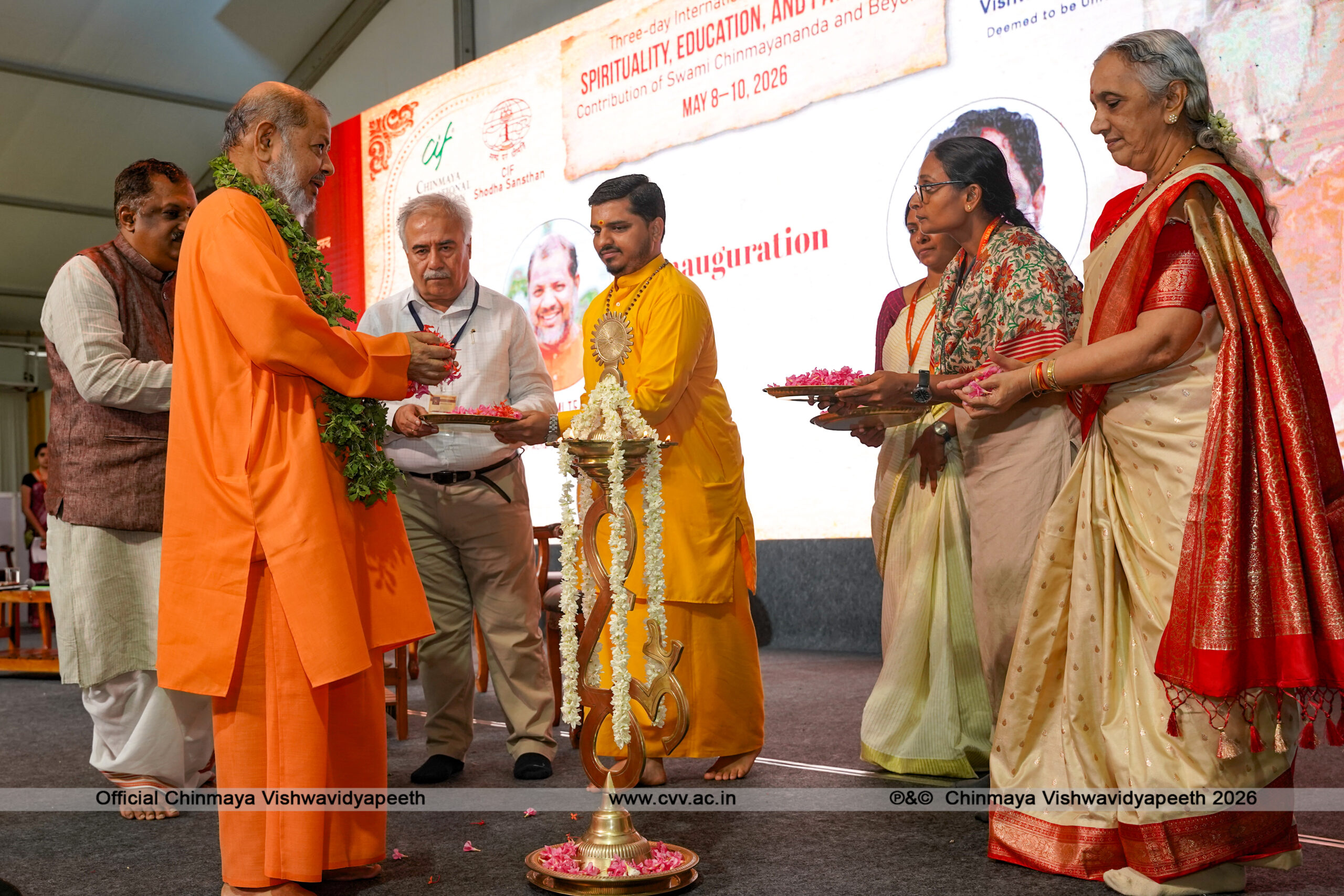
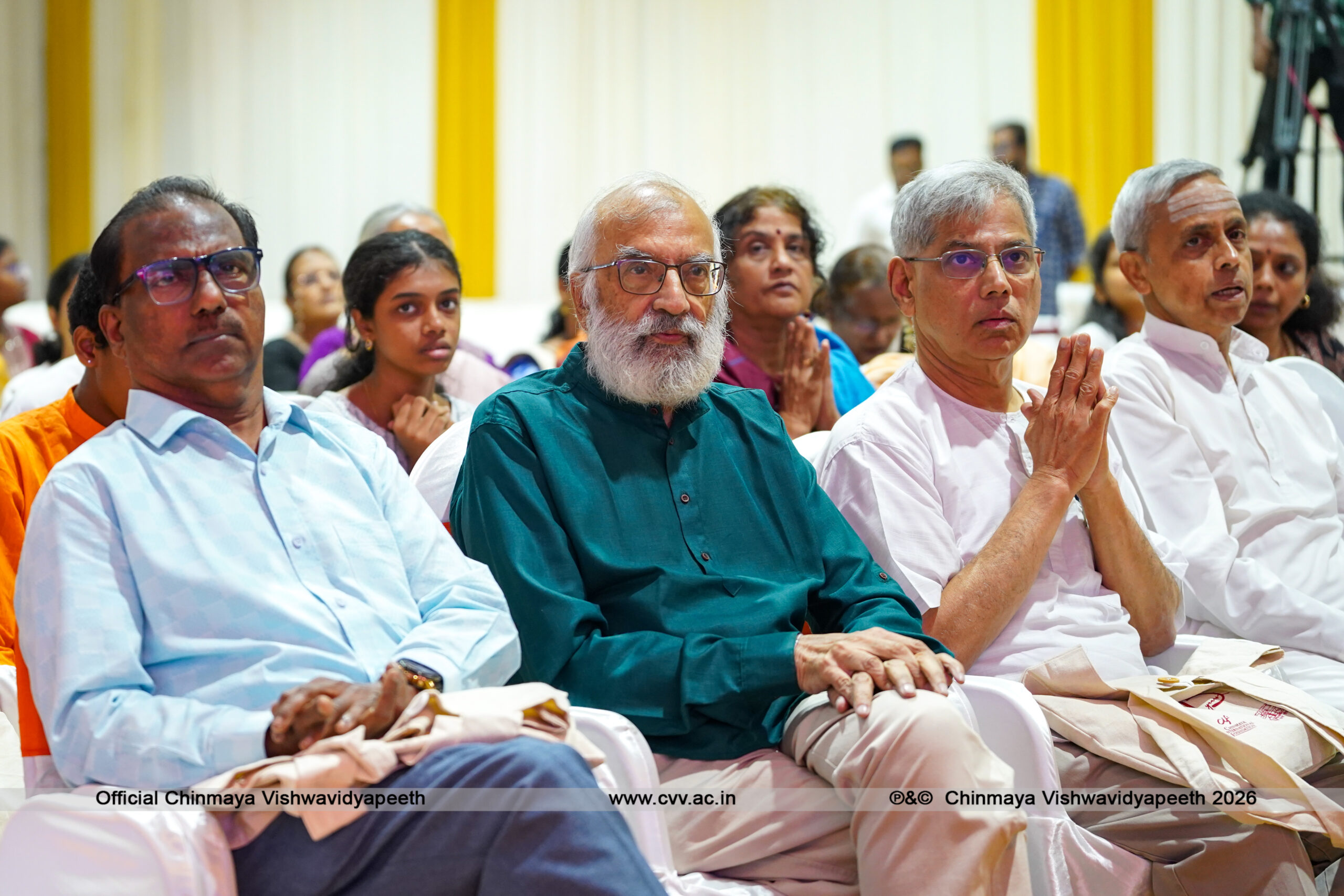
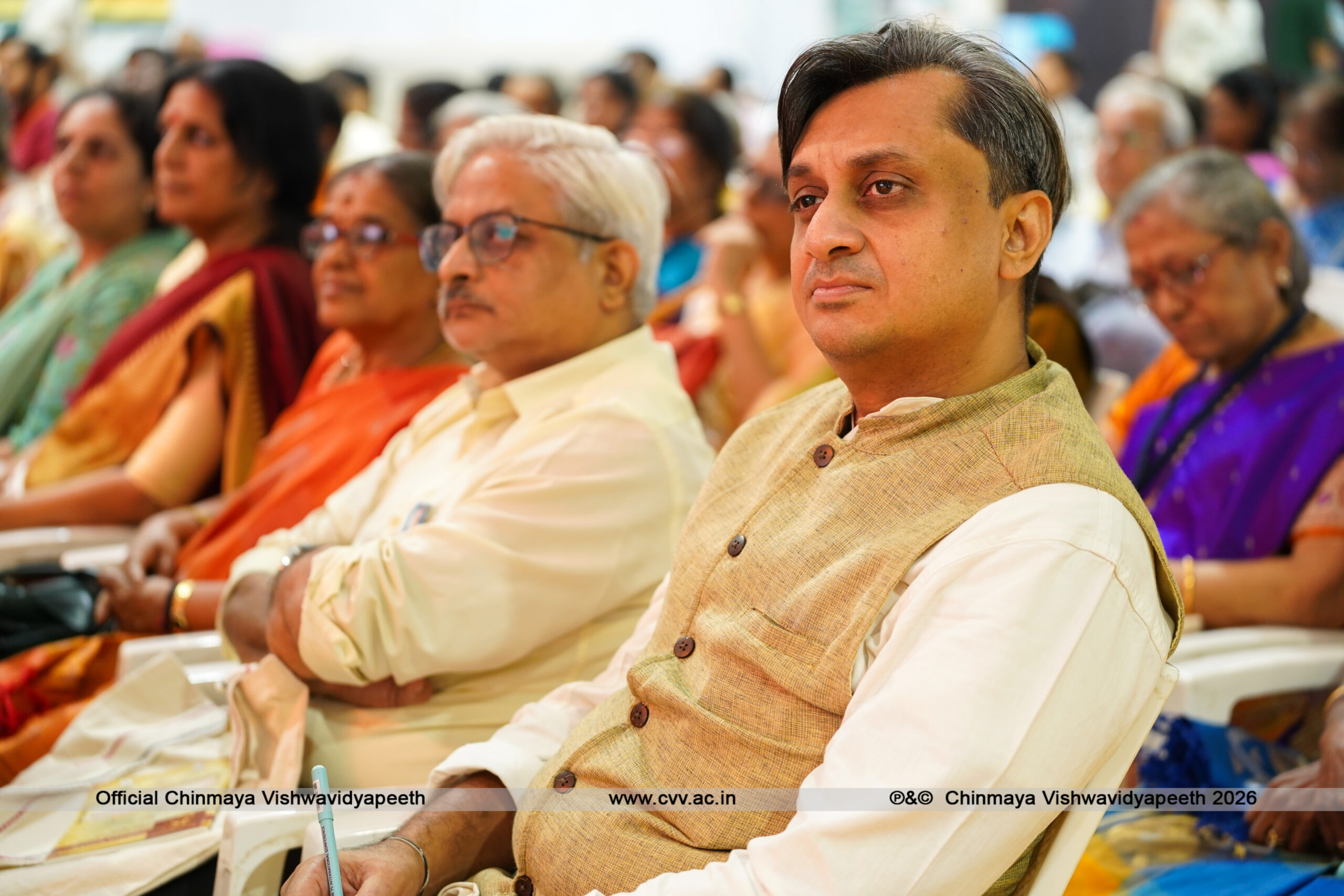
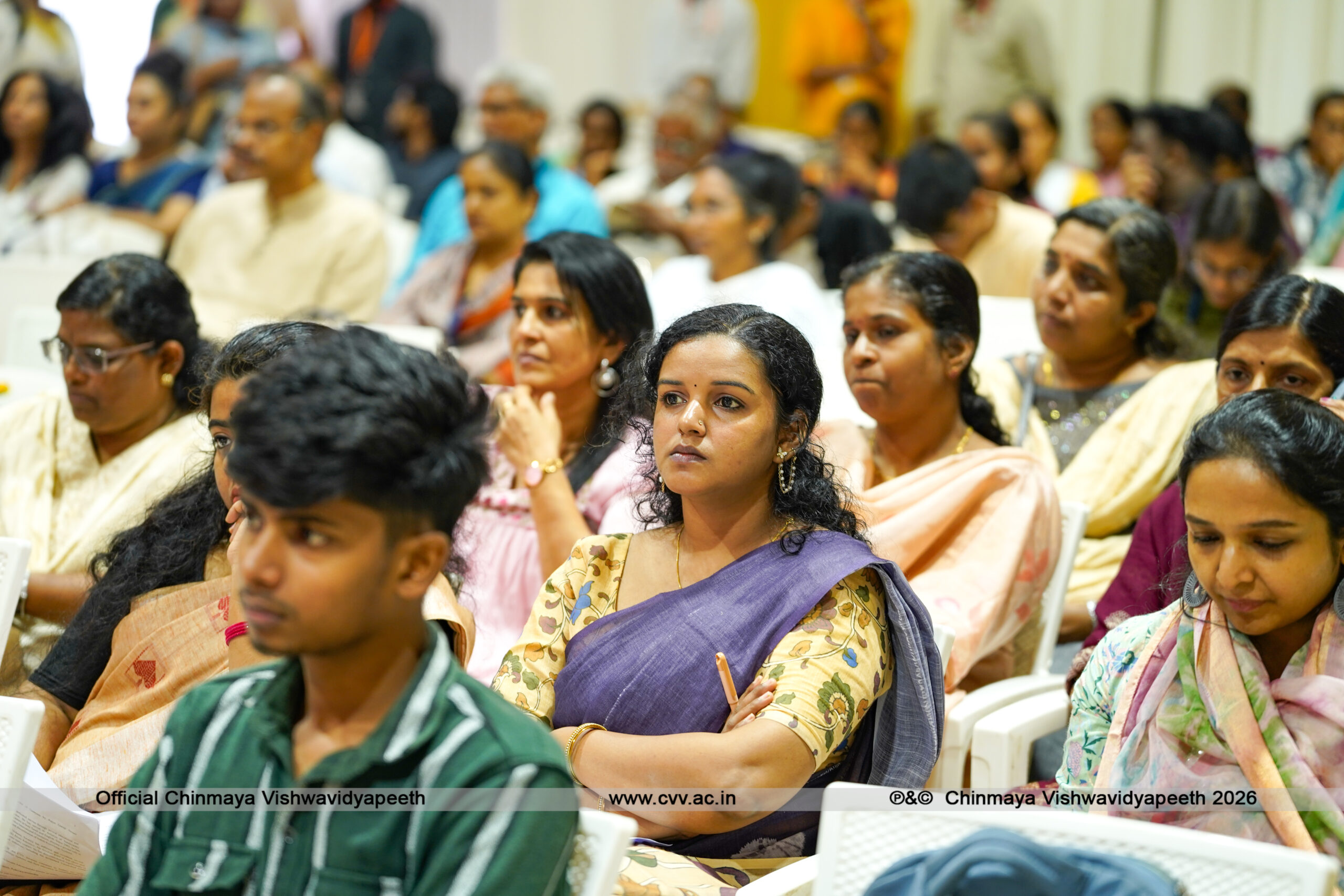
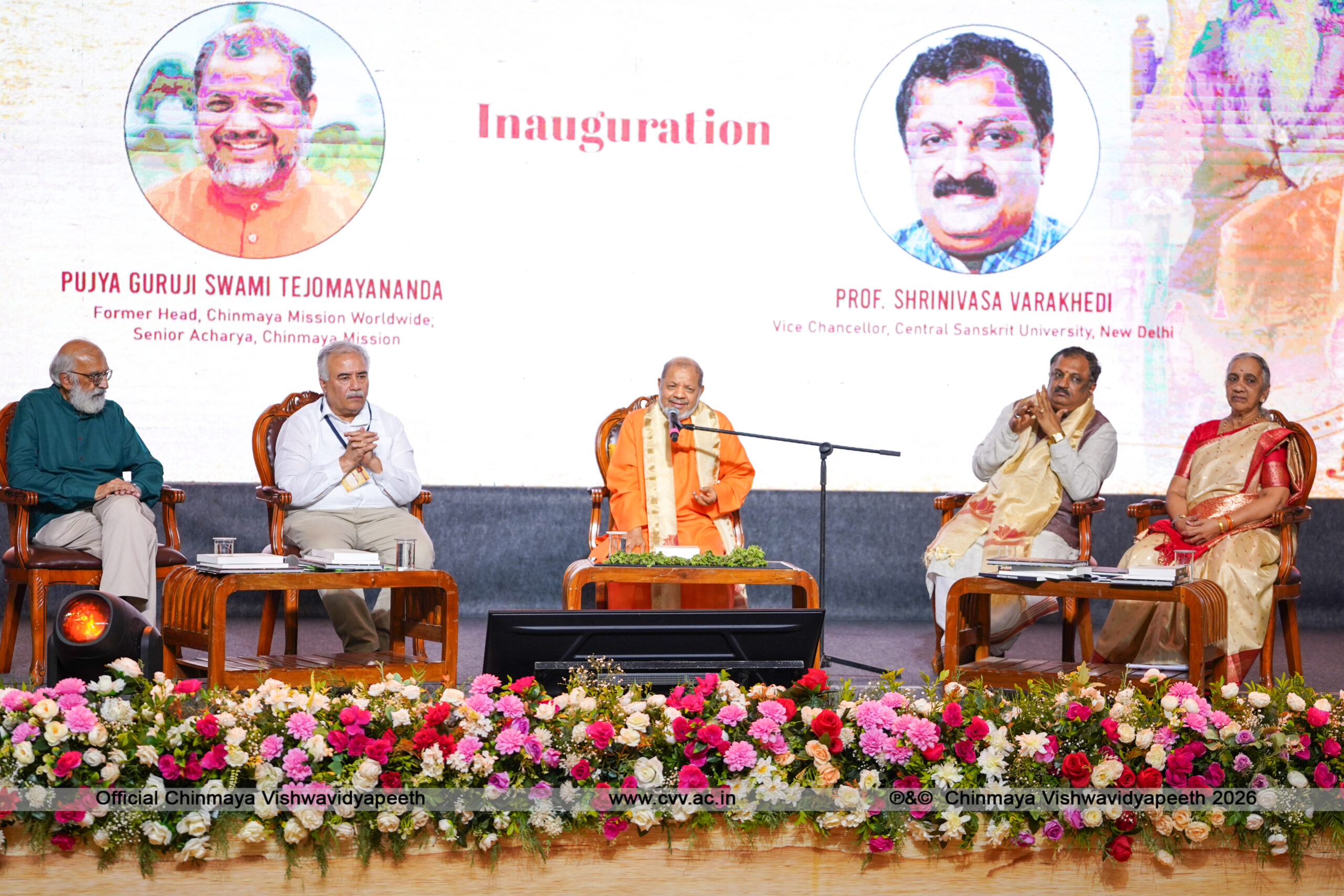
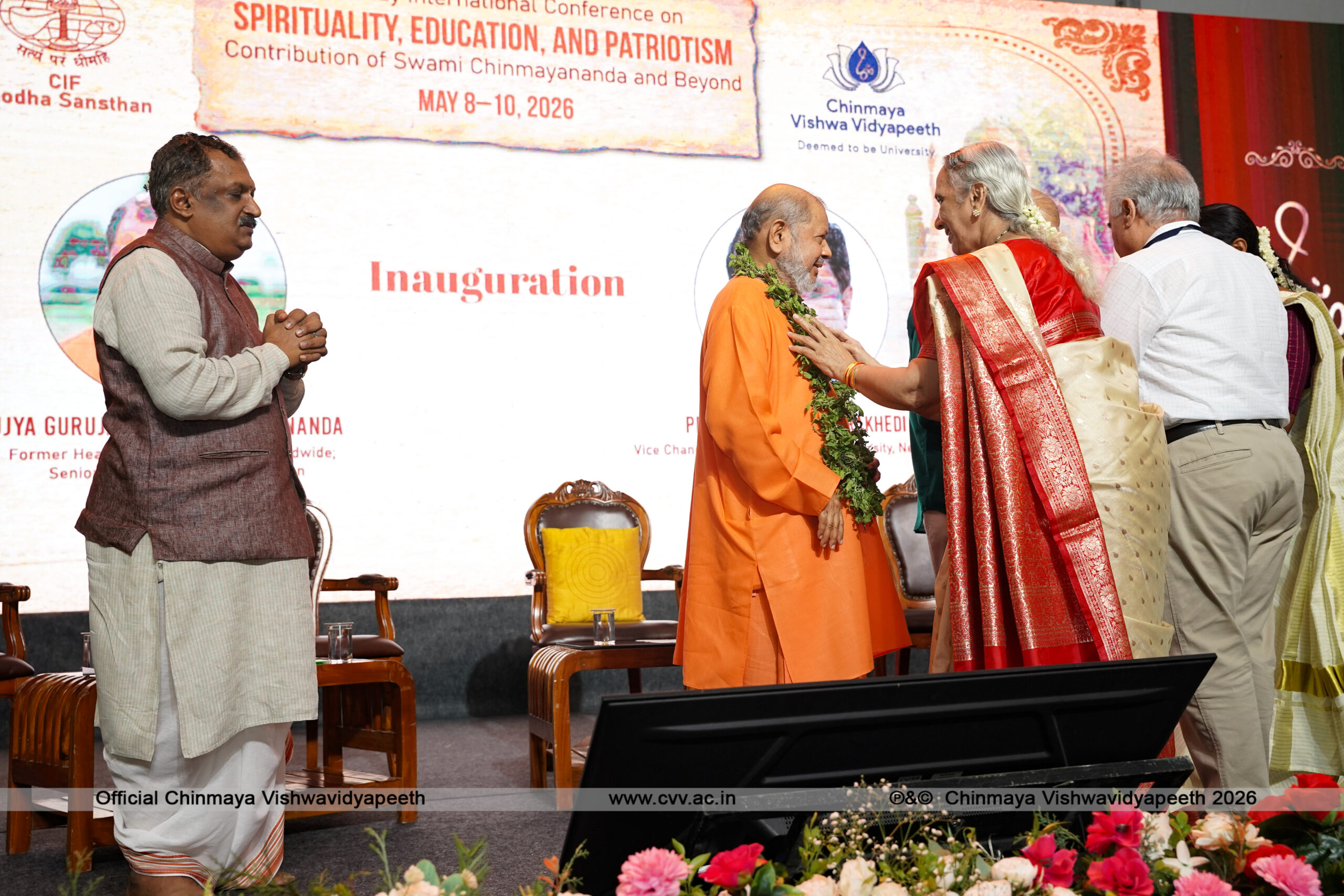
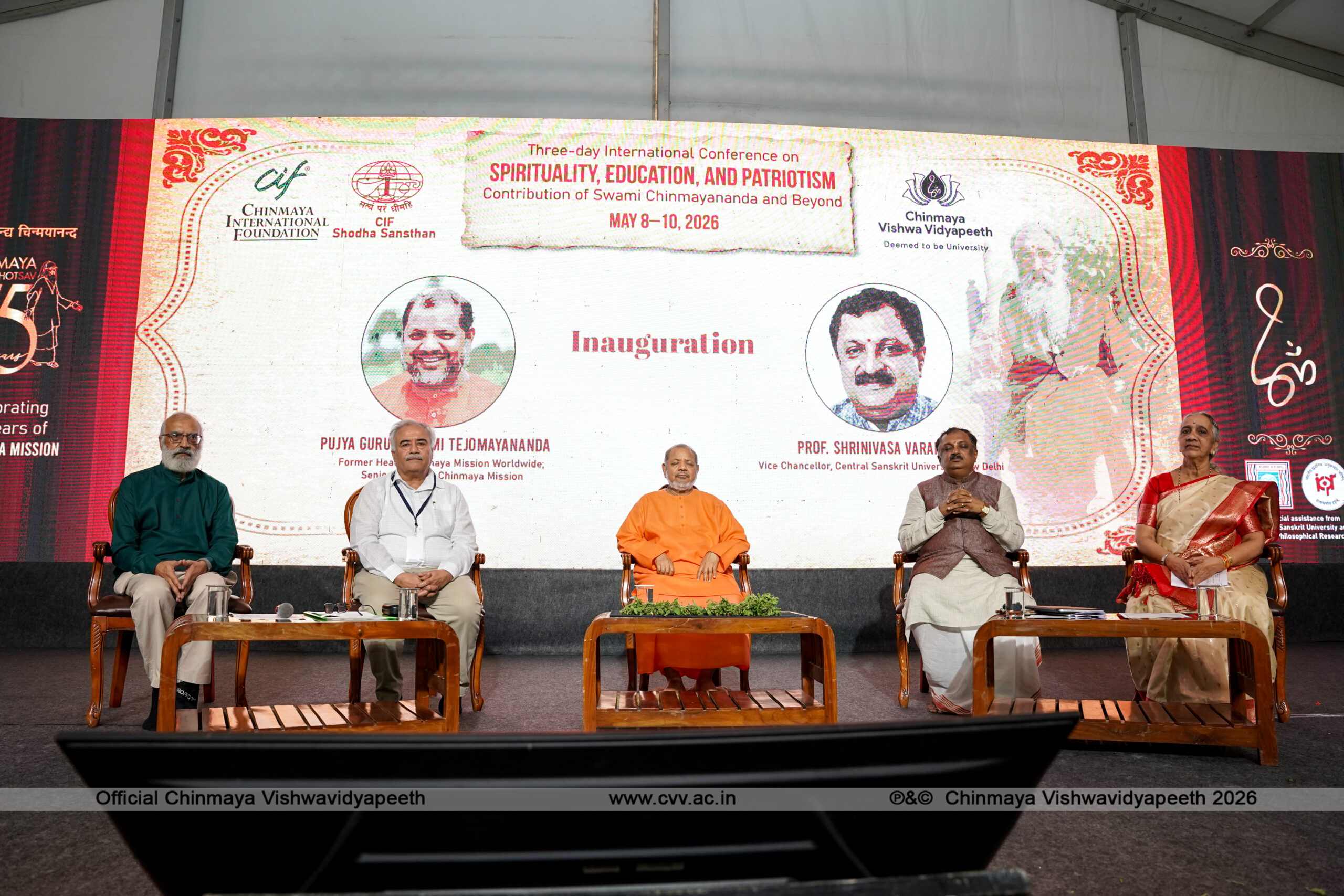
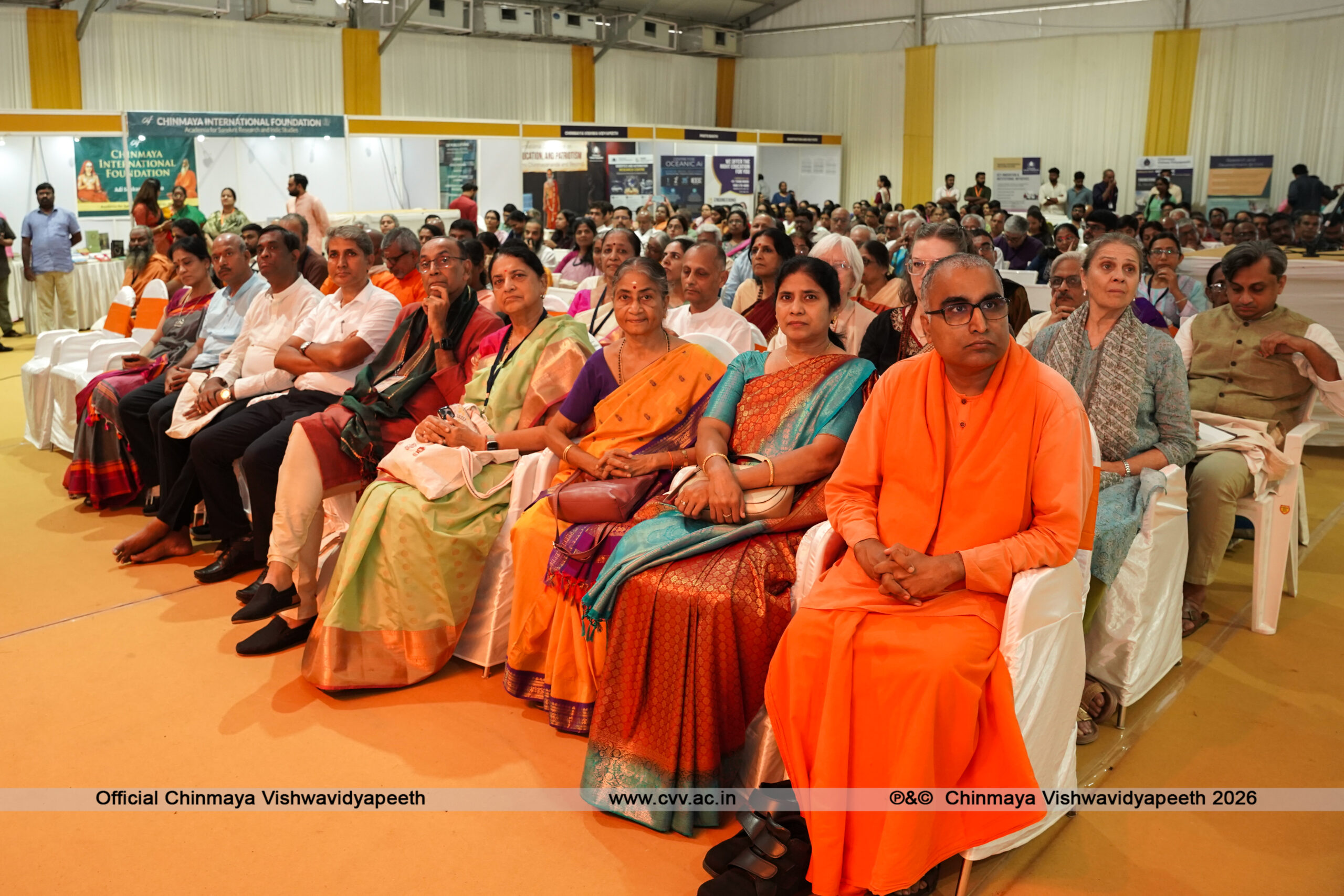
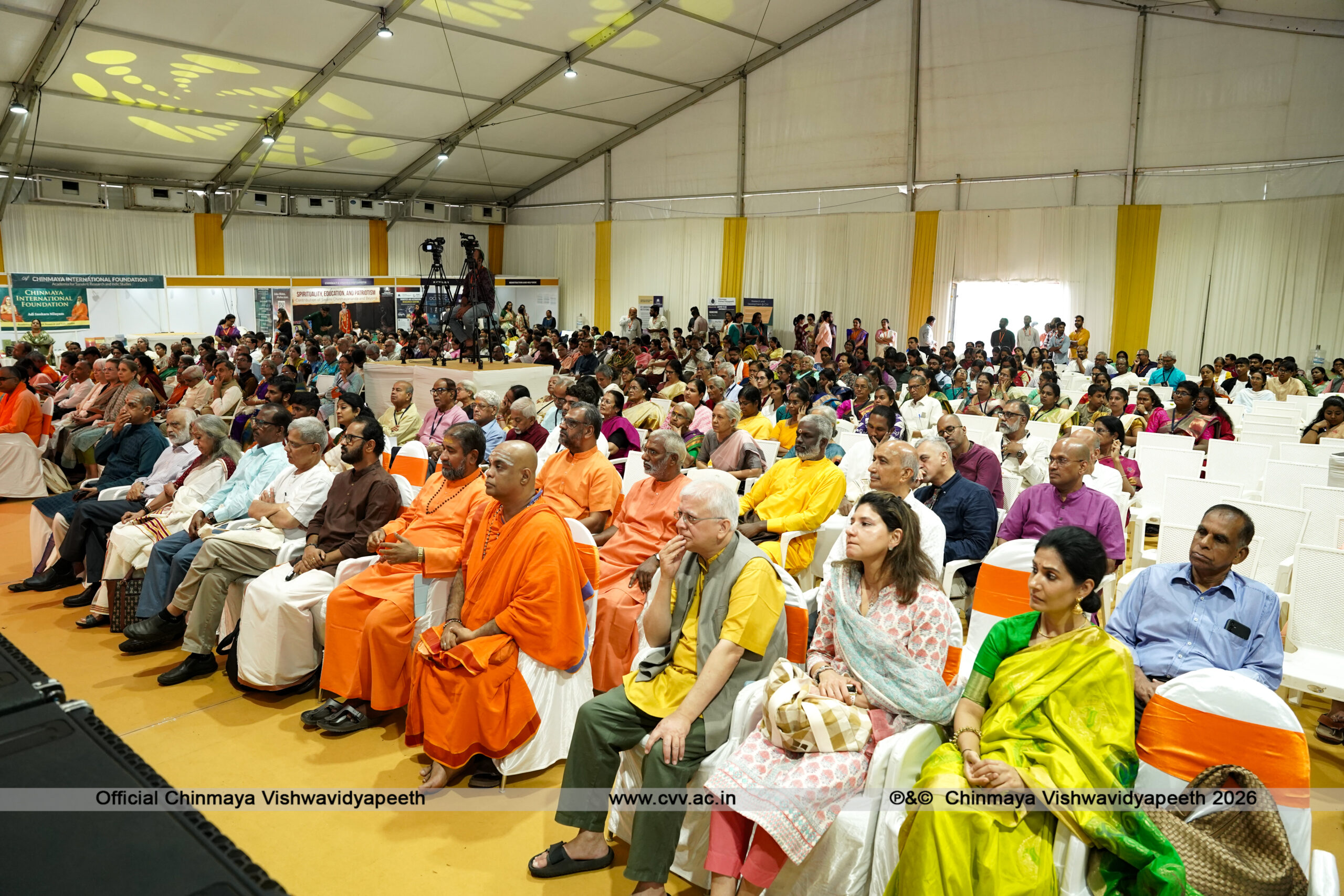
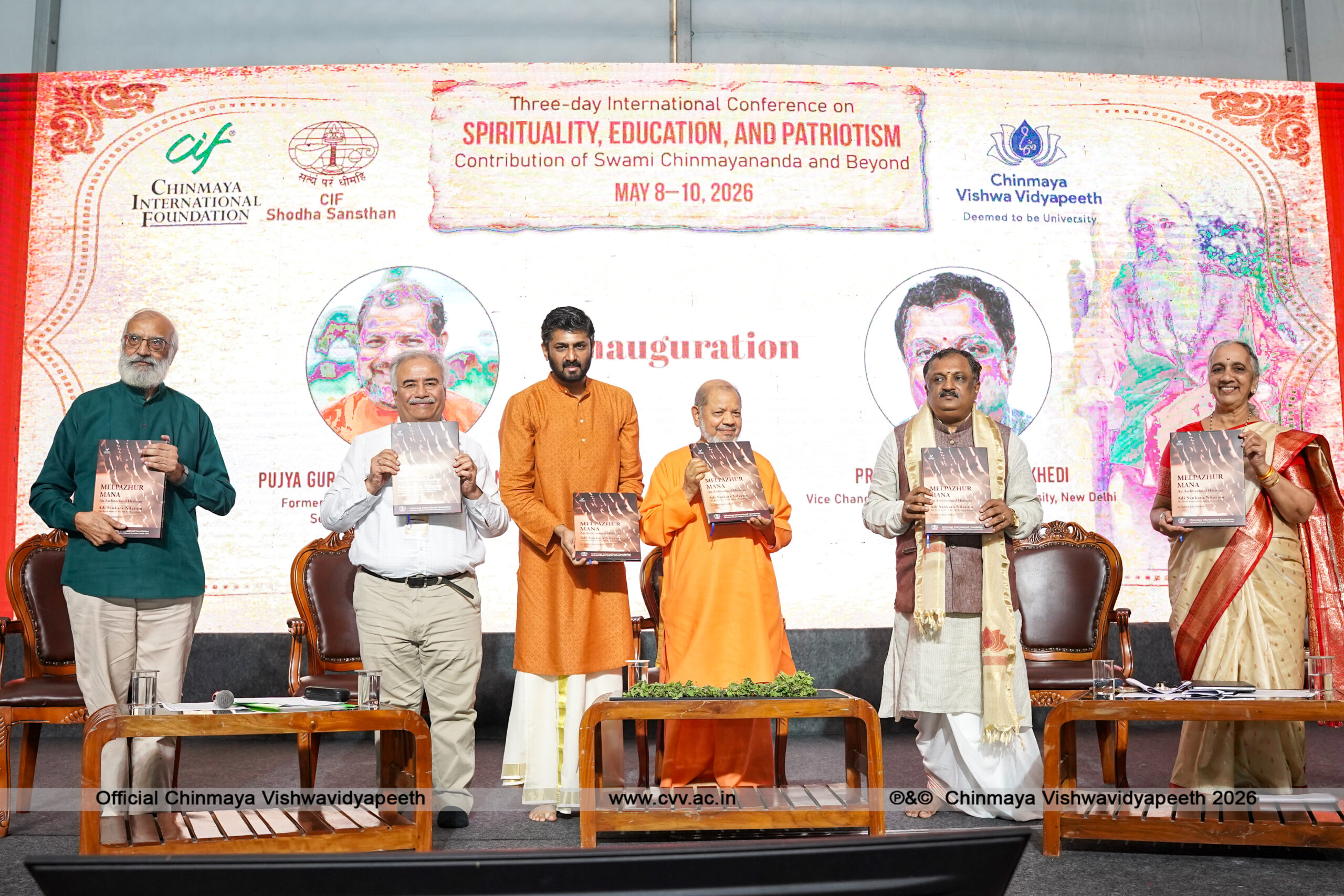
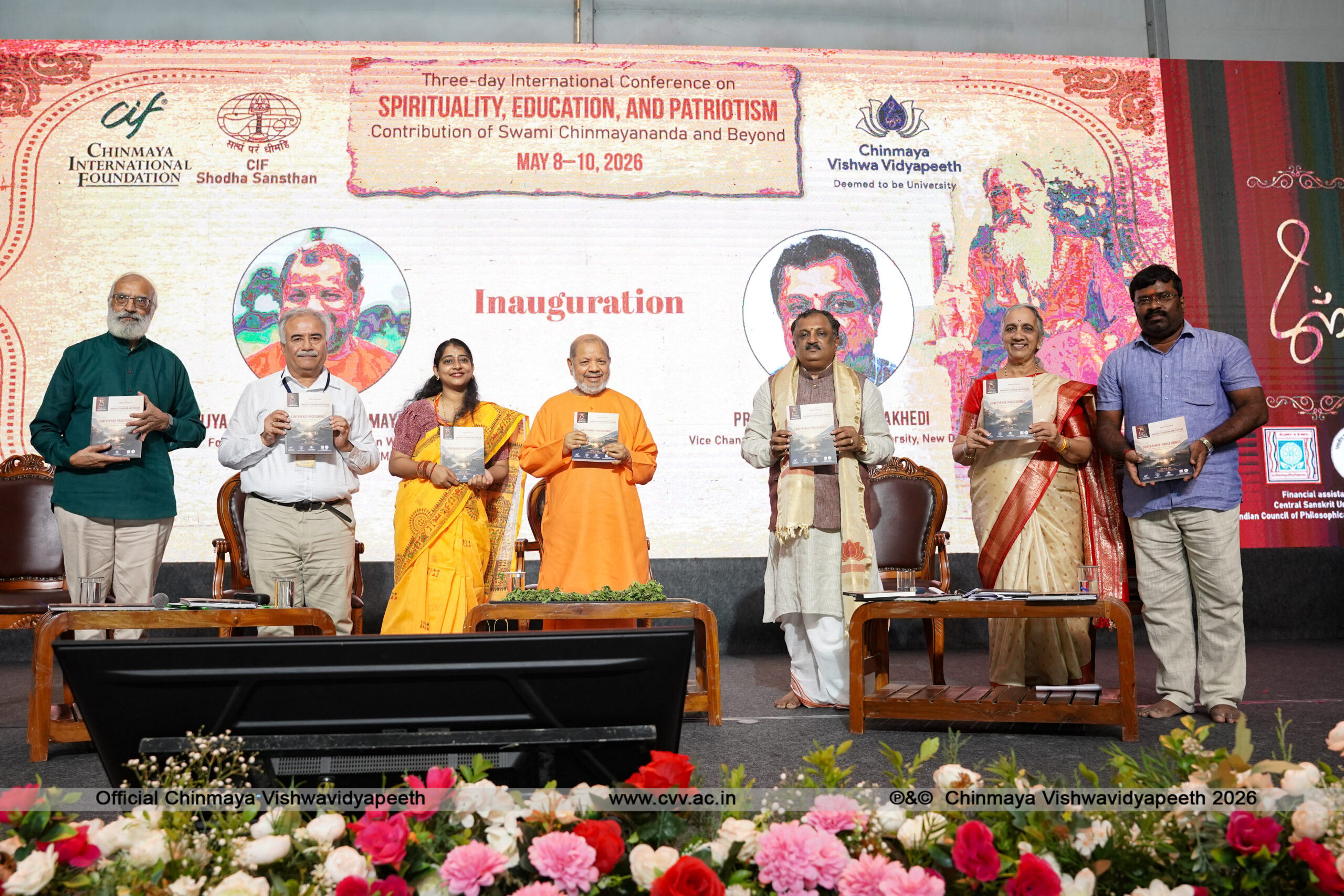
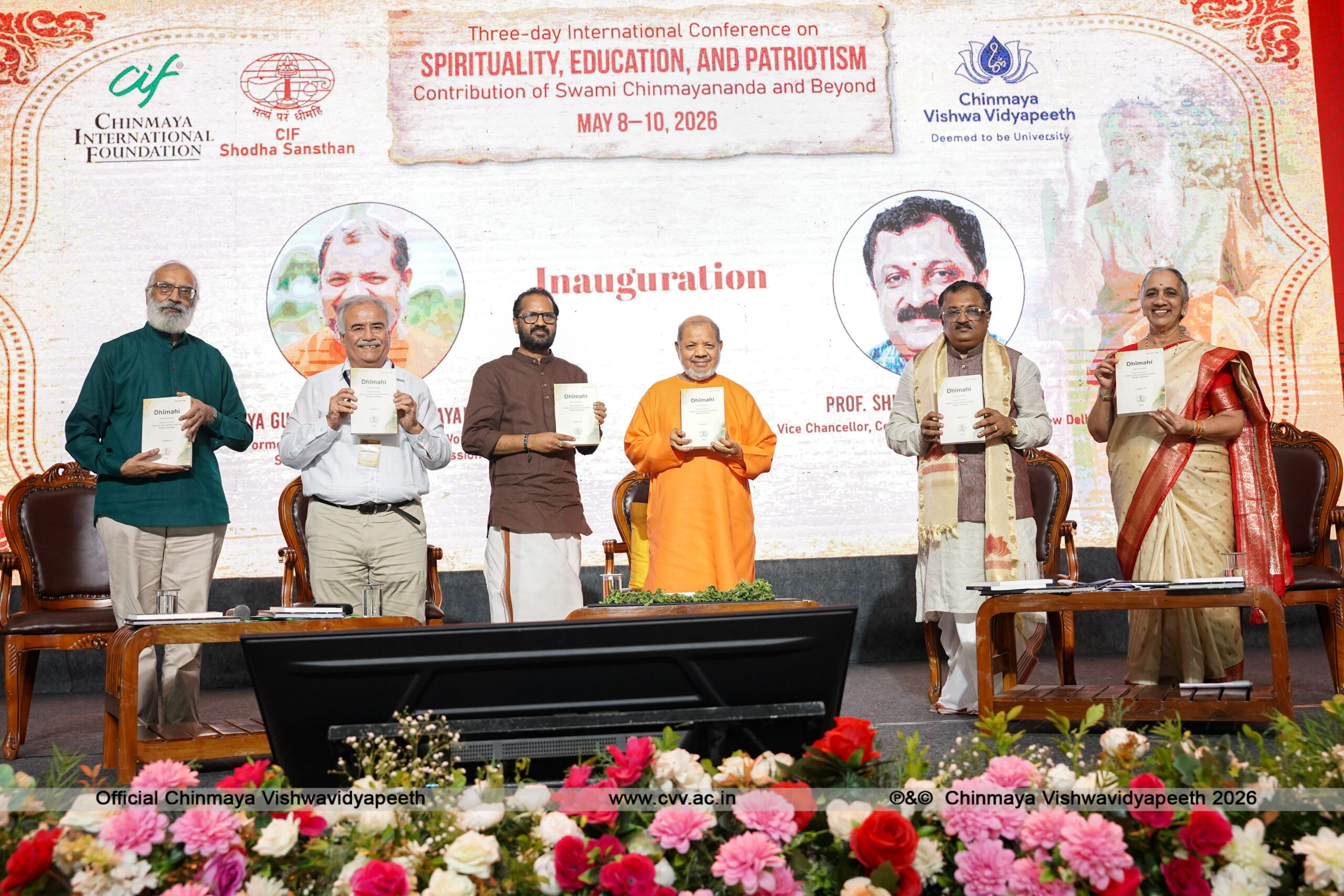
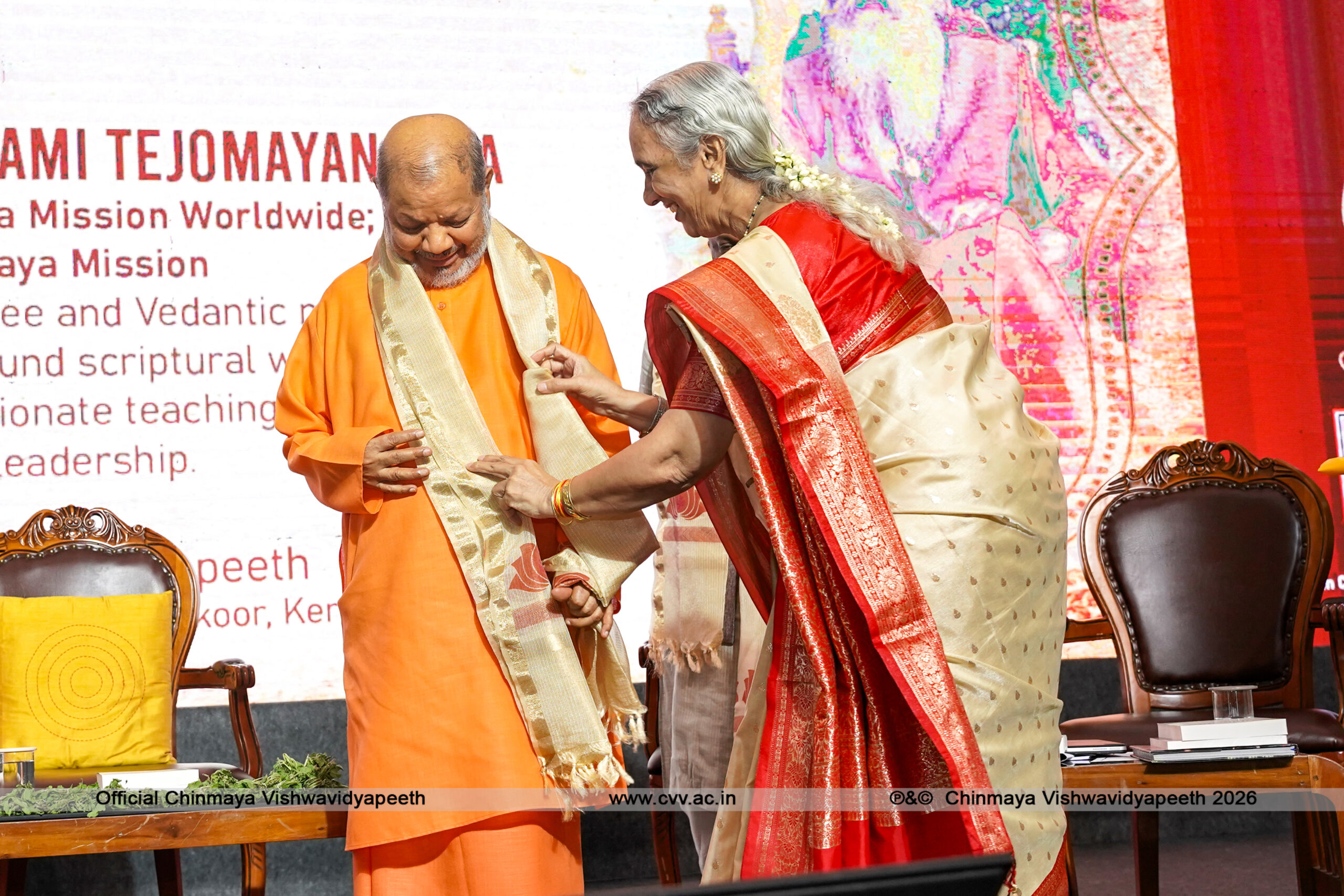
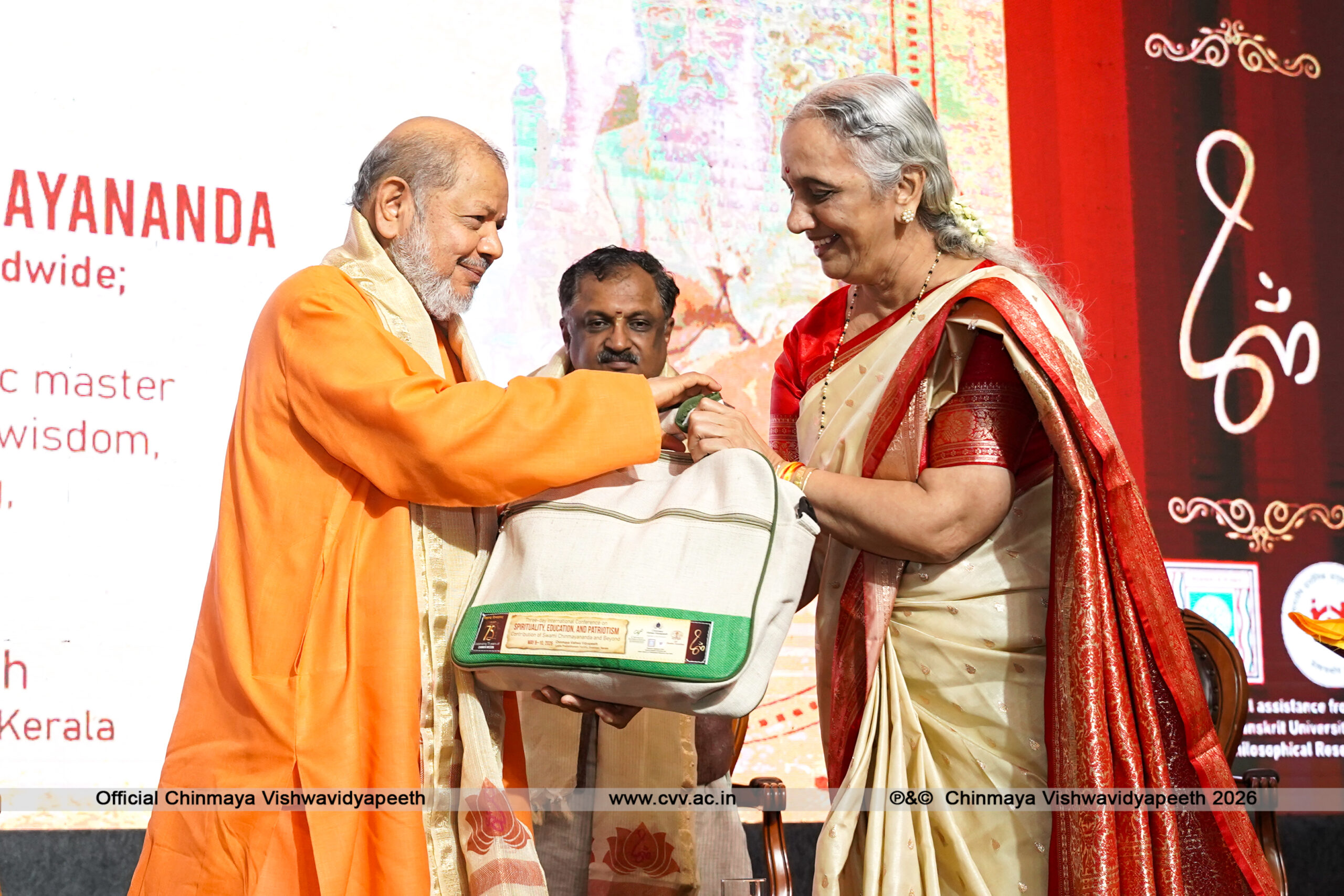
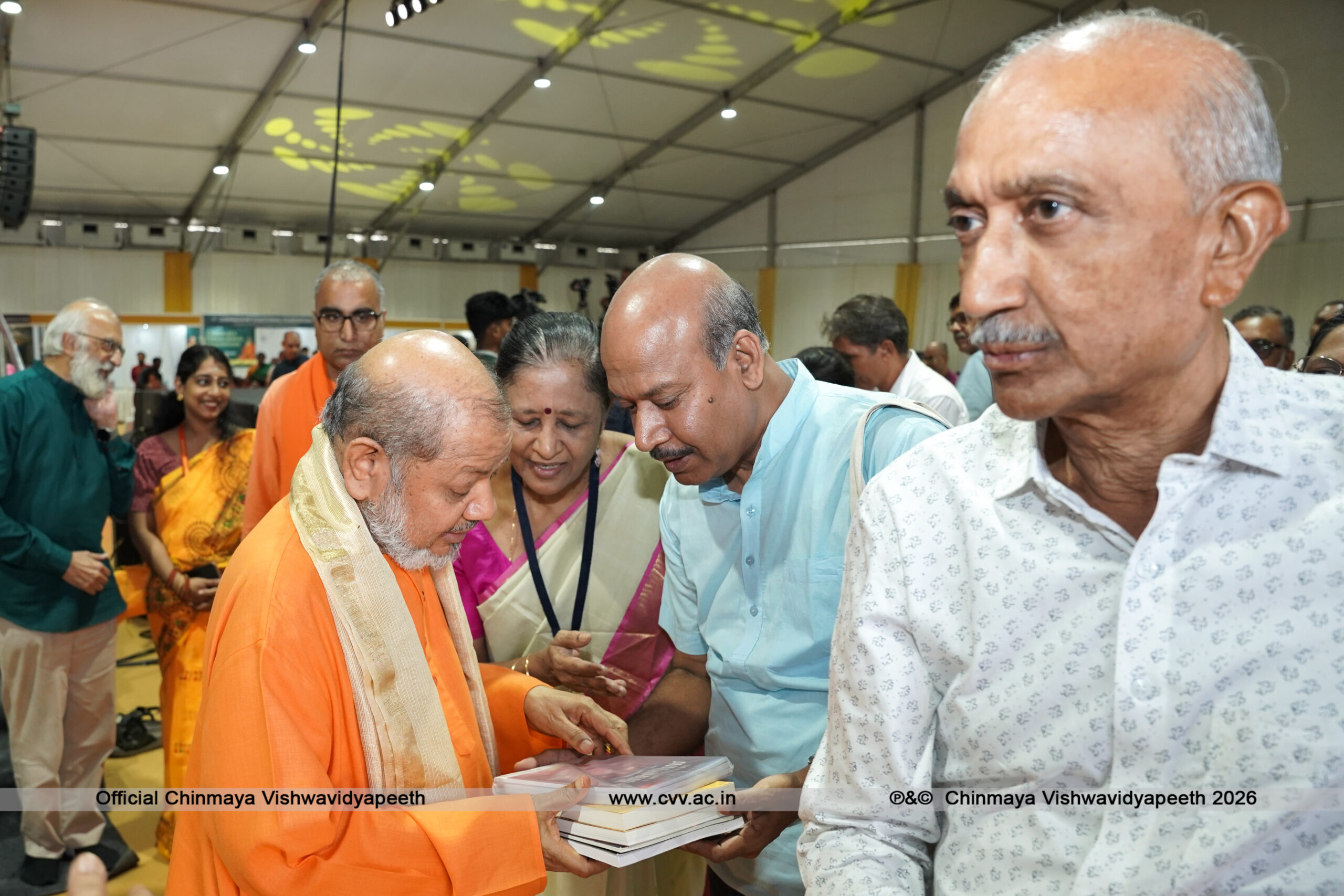
As a part of the celebration of 75 years of Chinmaya Mission, a three-day International Conference on “Spirituality, Education and Patriotism: Contribution of Swami Chinmayananda and Beyond” was held from 8–10 May 2026 at the Lalita Pratishthanam Facility, Onakkoor. The conference served as a vibrant platform for spiritual leaders, scholars, spiritual leaders, academicians, and students to explore the intersection of ancient wisdom and modern societal needs.
Inauguration
The inauguration ceremony commenced with the offering of Purnakumbha to Pujya Guruji Swami Tejomayananda, followed by a soulful invocation rendered by Smt. Pramodini Rao, Campus Director, CNBG campus.
In his welcome address, Prof. Manoj Arora, Vice Chancellor of CVV, emphasised the integration of spirituality with responsible citizenship. He highlighted the importance of nurturing values, character, and inner harmony through education and appreciated the role of Indian Knowledge Systems in shaping holistic individuals and a harmonious society.
Dr. Gauri Mahulikar, Academic Director of CIF | The Architect of Awakened Consciousness
Dr. Gauri Mahulikar focused on the vision and contributions of Swami Chinmayananda in transforming classical Indian wisdom into a practical framework for modern education, ethical living, and societal transformation. She explained that true education should awaken consciousness, character, responsibility, and inner harmony rather than merely impart information or technical skills. The session also reinforced the integration of Advaita Vedanta with multidisciplinary education, the role of Indian Knowledge Systems in holistic learning, spirituality as practical living and service, and the philosophy of man-making and woman-making. The vision of Vasudhaiva Kutumbakam and Lokasangraha was also discussed as essential foundations for global wellbeing and harmony.
Prof. Shrinivasa Varakhedi | Synthesising Adhyatmik Intelligence with Global Progress
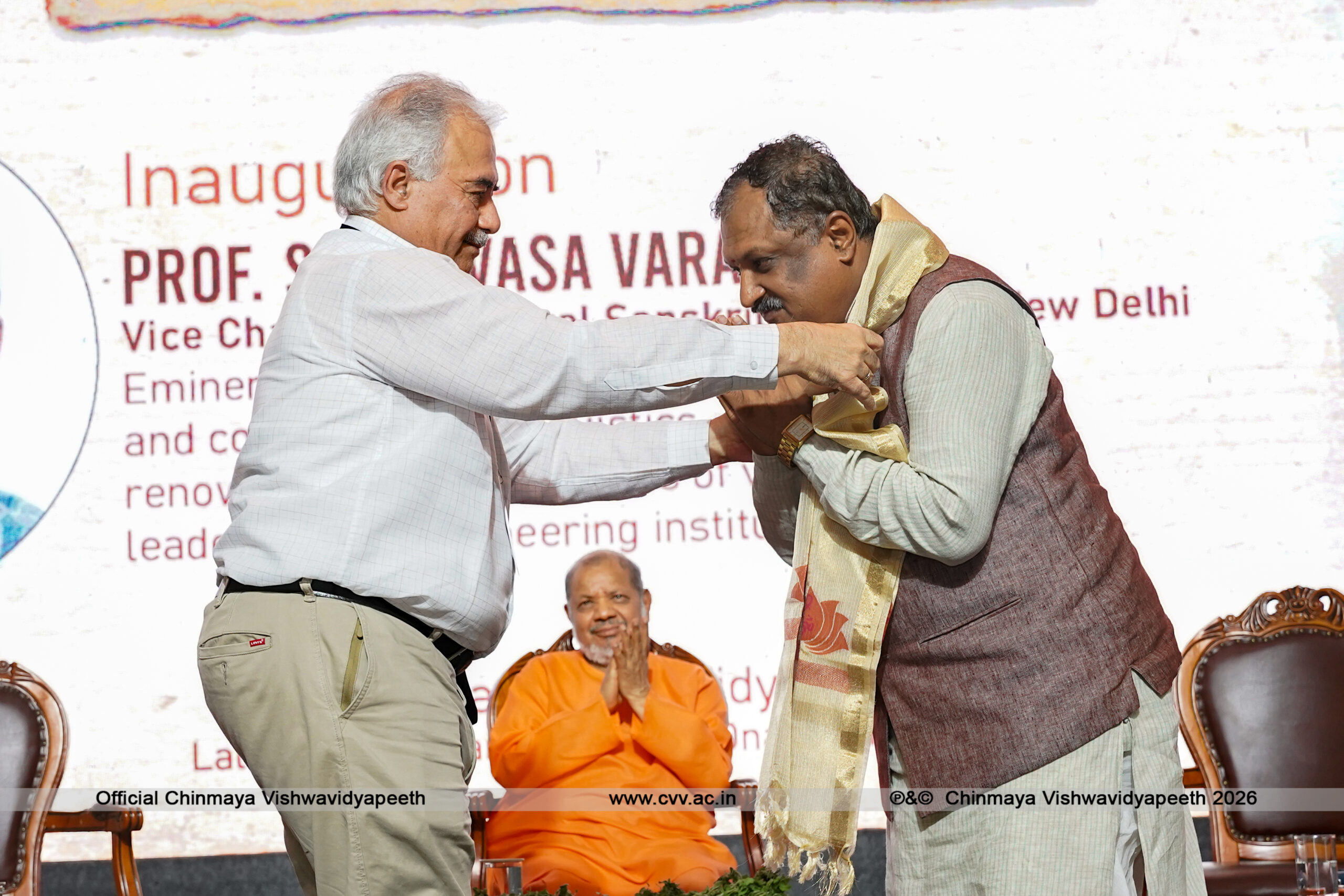
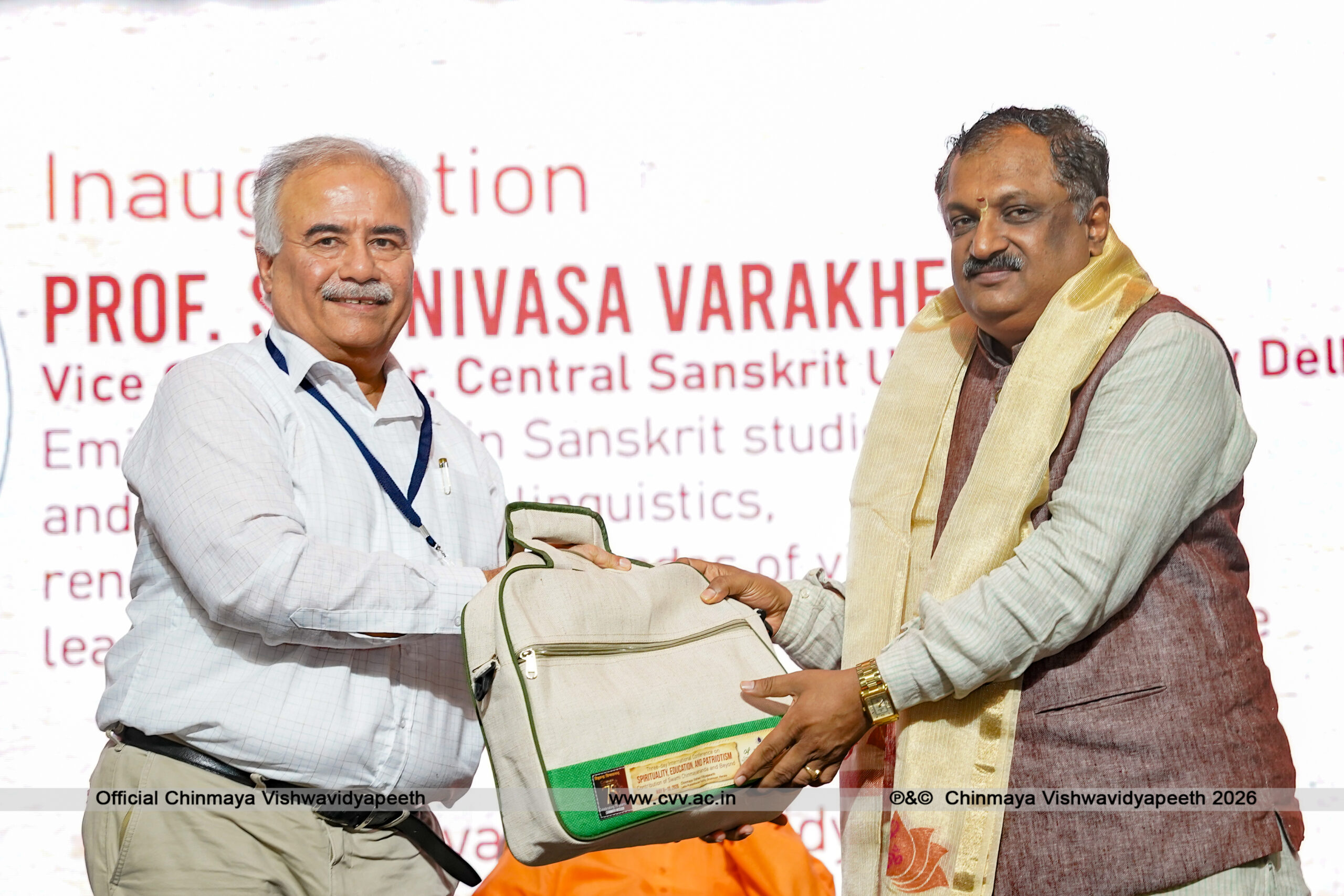
In the second session, Prof. Shrinivasa Varakhedi delivered a thought–provoking address on ‘Synthesising Adhyatmik Intelligence with Global Progress’. He presented a profound integration of Vedic wisdom with modern educational needs and explained how CVV reflects a harmonious confluence of science, spirituality, and education. Referring to the ‘Nasruddin syndrome’, he observed that humanity often searches externally for happiness while true fulfilment lies within. He highlighted the need to balance Artificial Intelligence with Spiritual Intelligence so that technological growth remains guided by ethical and spiritual values. He also emphasised Swadhyaya (self-study), Karma Yoga (selfless action) and value-based education as remedies to the commercialisation of education and highlighted patriotism rooted in Satyam Vada and reverence for all life as the path to sustainable global harmony.
During the conference, three significant books on spirituality, education, and Indian Knowledge Systems were released by the officiating dignitaries.
Pujya Guruji Swami Tejomayananda | The Spontaneous Radiance of Spiritual Perfection
Swami Tejomayananda reflected on spirituality through simple yet profound examples from daily life. He described the effortless joy of childhood that is simply rooted in purity, just like flowers radiating beauty and fragrance in their natural state. He said true spirituality lies in inner joy, simplicity, purity, and peaceful living. He went on to describe Swami Chinmayananda as a rare synthesis of Sanyasa and Yoga, combining renunciation with dynamic service and action. He stressed that the purpose of education is the manifestation of the perfection already present within every individual. Referring to the Bhagavad Gita ideal of ‘Sarva Bhuta Hite Ratah’, he stated that patriotism should be rooted in compassion and universal well-being.
Prof. Manoj Arora | Vice Chancellor, CVV
The Hon’ble Vice Chancellor highlighted the importance of spirituality, education, and patriotism in shaping responsible citizens and strong pillars of Bharat. He remarked that education without spirituality is incomplete, comparing it to water that is everywhere but unfit to drink. The address emphasised self-realisation, value-based learning, and the integration of IKS with Contemporary Knowledge Systems. He also expressed pride in CVV for organising such a unique and meaningful conference.
The inaugural session concluded with a formal vote of thanks delivered by the organising committee, celebrating the successful collaboration of minds aimed at building a more harmonious and inclusive society.
Day I – Session 1 – Keynote Address
Both speakers, Swami Advayananda and Prof. Anantanand Rambachan, reflected upon the philosophical vision of Sanātana Dharma and the contribution of Pujya Swami Chinmayananda in communicating Vedānta to contemporary society.
Prof. Anantanand Rambachan | Renunciation, Non-Attached Action, and Lokasaṅgraha: Toward an Engaged Advaita Vedānta
Prof. Anantanand Rambachan emphasised that renunciation is not the cessation of action in the world, but rather the transformation of action through an inner attitude of non-attachment. He explained that true renunciation becomes an internal condition rather than merely a change in external social status. Referring to the Bhagavad Gītā, he highlighted the concept of Lokasaṅgraha as the sustaining, protecting, and holding together of the world, and stated that renunciation can coexist with energetic social commitment. In this context, he pointed to Pujya Swami Chinmayananda as a living example of engaged Advaita rooted in service and spiritual wisdom.
Swami Advayananda, President, Chinmaya International Foundation
Swami Advayananda emphasised that Gurudev’s entire work was firmly based on the Prasthānatraya and deeply rooted in the authority of Śruti. He explained that Vedānta forms one of the most important dimensions of the Vedas and that Sanātana Dharma possesses the unique capacity to accommodate and evolve according to contemporary societal needs while remaining meaningful and purposeful. He noted that Gurudev taught Vedānta while remaining deeply grounded in tradition and made people develop a love for Vedānta through his distinctive style of teaching.
He further observed that Gurudev interpreted the Upaniṣads in a fresh and brilliant manner while keeping the teachings of Ādi Śaṅkarācārya as the foundation, citing examples from the Kenopaniṣad, Īśāvāsyopaniṣad, and the commentaries on the Bhagavad Gītā. He also remarked that Gurudev effectively used stories to communicate profound Vedāntic ideas and thereby made Vedānta attractive even to younger generations. He concluded by affirming that the spirit of Sanātana Dharma will continue to produce great teachers such as Vedavyāsa, Śaṅkarācārya, and Gurudev for the preservation of Dharma for eternity.
Day I – Session 1 – Panel Discussion
A panel discussion was hosted by Dr. Sunitha Grandhee featuring Dr. Vinayachandra Banavathy, Ms. Rudite J. Emir, and Dr. Siddhartha Nadkarni as panellists. The discussion explored the contribution of Pujya Swami Chinmayananda in communicating the philosophical wisdom of Vedānta to modern society.
Dr. Siddhartha Nadkarni observed that Gurudev possessed a unique ability to communicate profound philosophical insights not only to people in India but also to audiences across the world. He further stated that Gurudev himself was a living embodiment of Sarvātma-bhāva and non-duality, expressing the spirit of Advaita through his life and teachings.
Dr. Vinayachandra Banavathy remarked that Gurudev made a lasting impact on children and youngsters and played a major role in removing the inferiority complex that many Indians had regarding their own traditions. He noted that Gurudev was highly effective in presenting Vedāntic concepts before the urban, educated, and modern sections of Indian society. He also highlighted Gurudev’s remarkable ability to employ simple and ordinary language to communicate the extraordinary dimensions of Vedānta to all sections of society. Referring to Gurudev’s pedagogical methods, he mentioned the use of the BMI Chart as an innovative tool for explaining complex Advaitic concepts in an accessible manner.
Ms. Rudite J. Emir stated that Gurudev made philosophy alive and relevant to everyday life. Sharing her personal experiences with Gurudev, she explained how he made Vedānta approachable and understandable for all people. She further observed that Gurudev enabled individuals to face the challenges of life through the wisdom of Vedānta and effectively employed the concept of Jñāna Yajña to spread Vedāntic teachings among the masses.
Day I – Session 2 – Keynote Addresses on Spirituality
Both the speakers reflected upon the relevance of spirituality in contemporary life and the contribution of Pujya Swami Chinmayananda in presenting Vedānta to modern society, followed by a panel discussion and interactive Q and A session.
Prof. B. Mahadevan
Prof. B. Mahadevan stated that the entire work of Swami Chinmayananda and the Chinmaya Mission was fundamentally directed towards answering the question of why spirituality is necessary in human life. He observed that modern individuals have increasing problems for themselves and argued that spirituality alone can provide a lasting solution to such inner conflicts. Drawing from several corporate examples, he explained the importance of workplace spirituality and the need to cultivate spiritual values even in professional environments. Furthermore, he emphasised that spirituality requires constant investment and disciplined practice from an early age and should not be viewed merely as a pursuit after retirement. He further pointed out that Sarvātma-bhāva, compassion, and love constitute the very essence of spirituality. According to him, spirituality harmoniously accommodates qualities such as gentleness and strength, faith and broad-mindedness, as well as compassion and fearlessness.
Swami Sharadananda Saraswati, CIF
Swami Sharadananda Sarasvati observed that spirituality is often regarded as vague and disconnected from rational and disciplined enquiry, and stated that Swami Chinmayananda effectively addressed this misconception through his teachings and activities.
He explained that spirituality signifies the integration of thoughts, emotions, and actions towards a higher goal. Referring to the Indian tradition, he described spirituality as Adhyātma Vidyā, the critical enquiry into one’s true self-identity. He further clarified that spirituality does not imply withdrawal from worldly life, but rather the refinement and transformation of living itself. He also stated that spirituality essentially involves the removal of misidentification regarding the self.
Concluding his address, he remarked that through the teaching of Vedānta, Swami Chinmayananda successfully addressed many contemporary problems such as confusion, stress, and distraction.
Day I – Session 2 – Panel Discussion on Spirituality
The panel discussion hosted by Sri. Srinath Mohandas, Ph.D. Scholar, featured Ms. Christine Grimmer, Prof. P.C. Muraleemadhavan, and Shri. Ashok Grandhee. Sri Srinath Mohandas set the context for the discussion by highlighting the distinguishing features of Pujya Swami Chinmayananda and his unique contribution to spirituality and society.
Ms. Christine Grimmer
Ms. Christine Grimmer spoke about the methods adopted by Gurudev in imparting spiritual direction to Western audiences and explained how he made Vedāntic teachings understandable and relevant to them. She particularly emphasised Gurudev’s deep compassion and observed that it enabled him to address several contemporary issues such as anxiety, stress, and emotional struggles faced by modern individuals.
Prof. P. C. Muraleemadhavan
Prof. P. C. Muraleemadhavan discussed the pedagogical methods employed by Gurudev in communicating Vedāntic concepts and inculcating spirituality among seekers. He remarked that Gurudev created a strong psychological impact upon the minds of seekers through his spiritual teachings and especially highlighted Gurudev’s interpretation of Śravaṇa, Manana, and Nididhyāsana as essential stages of spiritual growth.
Sri Ashok Grandhee
Sri Ashok Grandhee elaborated upon the unique features of the two-year Vedānta course conducted at Sandeepany Sādhanālaya, which was structured according to Gurudev’s vision of Vedāntic sādhana and inner transformation. He explained that the syllabus of the course was carefully designed for the holistic and spiritual growth of students. He further noted that Gurudev established various platforms, such as Balavihar and CHYK, to nurture spiritual ambassadors in society similar to Swami Vivekananda. He also remarked that Gurudev democratised the teachings of Vedānta and successfully brought dynamism into spirituality. Responding to a question raised by the host, he stated that spiritual teachings can also be effectively imparted to corporate leaders without diluting their essence.
The session concluded with the summarisation [RS1] of the major themes by Sri Srinath Mohandas.
Cultural Programme by CVV Students
Day II – 9th May 2026
Day II – Guest of Honour Address by Swami Narasimhananda, _______________
In his address, Swami Narasimhananda focused on the spiritual, educational, and patriotic contributions of Swami Chinmayananda and the relevance of Indian spiritual traditions in modern society. The speaker highlighted Swami Chinmayananda’s efforts in making the teachings of the Bhagavad Gita and the Upanishads accessible to ordinary people through simple language, practical interpretation, and organised spiritual education. His mission was to present traditional wisdom that is understandable to people from all walks of life.
He emphasised the importance of understanding Bharatiya Darshana through traditional commentaries and practical realisation rather than merely theoretical study. The speaker explained that Advaita Vedanta is not just a philosophical concept but a way of life that must be practised and experienced. He reflected on the teachings of Swami Vivekananda and described spirituality as the backbone of India and its greatest contribution to the world. There was a strong emphasis on Swami Vivekananda’s inspiring speeches after returning from the West and his vision of ‘man-making education’ rooted in character, self-confidence, and spiritual awareness. The speaker criticised modern education systems for focusing mainly on niyukti (employment) instead of vimukti (liberation and inner growth). He stressed that true education should develop values, self-realisation, and responsibility toward society.
He strongly emphasised the role of the Indian middle class and grihastha (householder) in social transformation. Families are encouraged to introduce children to the teachings of the Upanishads and the Gita from an early age. The speaker also questioned why Sanskrit learning is often neglected and the need to revive Sanskrit through structured learning. The address further reflected on India’s rich manuscript heritage and the need to preserve and study ancient knowledge systems. The speaker reminded the audience that Indians belong to the great Rishi Parampara as ‘Rishi Putras’ and emphasised that spirituality should go beyond rituals and become a lived experience based on Vedantic principles. He called for gratitude toward great spiritual masters through the practical application of Vedanta in daily life and social conduct.
The session concluded with a hopeful vision for India’s future spiritual leadership. The speaker expressed confidence that by 2047 India would emerge as a guiding force for the world through spirituality, cultural confidence, and Advaitic wisdom. The audience was encouraged to reconnect with Sanatana Dharma, Upanishadic teachings, and the ideals of great spiritual leaders such as Swami Vivekananda and Swami Chinmayananda, thereby contributing to both individual transformation and national progress
Day II – Session 3 – Keynote Address on Education
The two distinguished speakers, Dr. Shakunthala Nagpal, former Head of Teacher Education and Extension at NCERT, New Delhi, and Swami Anukoolananda, Resident Director, Chinmaya International Residential School (CIRS) were warmly welcomed in recognition of their valuable contributions to education, research, spirituality, and holistic human development. Dr. Ramesh Pattni, Director, Centre of Excellence for IKS-CKS Integration and Innovation at CVV, felicitated them on behalf of the organising committee.
Dr. Shakunthala Nagpal | Education, Spirituality and Patriotism: Contribution of Swami Chinmayananda and Beyond
Prof. Nagpal’s address focused on the urgent need to transform modern education into a more holistic and value-based system by integrating Vedantic wisdom with contemporary learning. Referring to Albert Einstein’s statement that science without religion is blind and religion without science is lame, she argued that society today is progressing rapidly but without moral and spiritual direction. Modern education, according to her, has become excessively focused on measurable academic achievement while neglecting emotional, physical, ethical, and spiritual development. She explained that Indian thinkers such as Mahatma Gandhi, Swami Vivekananda, and Sri Aurobindo envisioned education as a process of developing the whole human being. India once possessed rich indigenous knowledge traditions covering philosophy, science, mathematics, health, and arts, but globalisation and modern systems have distanced learners from these roots.
Prof. Nagpal identified several factors responsible for the imbalance in education. First, the system is heavily product-oriented, emphasising marks, grades, and examinations while ignoring emotional values and practical skills. Learning has become mechanical and result-driven. Second, intelligence is narrowly understood as IQ alone, while Emotional Intelligence (EQ) and Spiritual Intelligence (SQ) are often neglected. She emphasised that true intelligence arises when the mind is purified through self-discipline, meditation, and self-awareness. Unlike Artificial Intelligence, which merely processes data, spiritual intelligence involves consciousness, compassion, and ethical sensitivity. Third, current assessment systems remain reductionist and cognitively biased. Although psychological models recognise multiple dimensions of intelligence, schools still evaluate students mainly through academic performance. Fourth, behavioural sciences often lack clarity regarding concepts such as values, beliefs, attitudes, and perceptions, making the integration of spirituality into education difficult. Fifth, modern education is deeply influenced by deterministic scientific thinking, which emphasises objectivity and prediction but overlooks meaning, purpose, and consciousness.
As a solution, Prof. Nagpal proposed the integration of Vedantic philosophy into education. Vedanta, which focuses on self-knowledge and consciousness, provides a framework for balanced human development. Swami Chinmayananda was highlighted as a visionary who interpreted Vedantic teachings for modern society. She also referred to the Bhagavad Gita, which describes the hierarchy of body, senses, mind, intellect, and Self, emphasising that the Self is the most powerful guiding force in human life.
The concept of the three Gunas: Tamo, Rajo, and Sattva was also discussed. Tamo Guna represents laziness and ignorance, Rajo Guna represents activity and desire, and Sattva Guna symbolises purity, wisdom, and harmony. Understanding these qualities can help guide students toward careers suited to their personalities and abilities. Prof. Nagpal stressed that education must prepare students for emerging careers while nurturing creativity, adaptability, and emotional maturity. She appreciated the National Curriculum Framework 2023 for restoring vocational education and promoting the dignity of labour, skills, and social responsibility.
An important idea presented was ‘education for all the senses’. Different individuals learn through different sensory strengths such as hearing, sight, touch, taste, and smell. Therefore, education should equally value careers in music, design, culinary arts, textiles, photography, and related fields, enabling students to discover their unique talents. To support holistic development, Prof. Nagpal introduced the 4H Model of Education: Head, Heart, Hand, and Highway. ‘Head’ represents intellectual growth, ‘Heart’ emotional and moral development, ‘Hand’ practical skills, and ‘Highway’ digital literacy and responsible use of information technology. Together, these dimensions aim to balance cognitive, emotional, practical, and spiritual growth.
Finally, Prof. Nagpal stressed the importance of quality teacher education. Teachers should become reflective practitioners who guide students intellectually, emotionally, spiritually, and digitally. By combining modern education with Vedantic wisdom, schools can nurture compassionate, self-aware, and responsible individuals. She concluded with the inspiring idea that education should not merely fill minds with information but awaken the inner potential already present within every human being.
Swami Anukoolananda | __________________________
Swami Anukoolananda began with appreciating the uniqueness of the conference, noting that despite the scholarly nature of the gathering, it was filled with warmth, reflection, and joy. The seminar was described as a landmark event that would influence educational thinking for years to come. To understand Gurudev’s educational philosophy, he emphasised the need to understand Gurudev himself. Swami Chinmayananda was presented as a fearless patriot, revolutionary thinker, and spiritual reformer who challenged social stagnation, injustice, caste discrimination, and narrow divisions in society. His spirituality was not passive but active, transformative, and socially responsible.
The discussion then moved to the historical context of Indian education. Colonial educational policies, especially those associated with Thomas Babington Macaulay, were criticised for alienating Indians from their own cultural and intellectual heritage. The colonial system aimed to produce individuals who were ‘Indian in blood but English in taste and intellect’, leading to the gradual neglect of India’s rich traditions in philosophy, science, literature, and spirituality. Swami Chinmayananda believed that India required not only political freedom but also intellectual and cultural reawakening. According to him, social transformation begins with individual transformation. Character forms the foundation of personality, and values form the foundation of character. Therefore, education must move beyond mere information transfer and consciously cultivate noble values.
After studying philosophies across the world, Gurudev became convinced that the timeless values of Sanatana Dharma possess universal relevance. These values promote harmony, compassion, discipline, peace, and universal brotherhood. To spread these ideals, Gurudev established the Chinmaya Mission and initiated grassroots educational programs for all age groups. Bal Vihar programmes were introduced for children, youth activities were designed for leadership and character building, and study groups were organised for adults. These programmes are aimed at holistic human development and eventually expanded into schools, colleges, and universities such as Chinmaya Vidyalaya and Chinmaya Vishwa Vidyapeeth.
Gurudev viewed education as the training of both the ‘head and the heart’. He believed that education should help individuals face personal, social, and national challenges with wisdom and courage. He repeatedly stressed that discipline alone is insufficient unless unhealthy values are replaced with constructive ones such as integrity, compassion, selflessness, and service. The session also examined the meaning of value-based education. Modern education has become heavily mark-oriented, where academic success is measured mainly through examination scores. In contrast, Gurudev emphasised that marks should only be the by-product of excellence, not the primary aim of education. True education should be value-oriented rather than mark-oriented.
The talk further discussed the emergence of the Chinmaya Vision Program, a structured educational framework inspired by Gurudev’s ideas. Educational thinkers in the 1990s systematically developed this programme using Gurudev’s writings and speeches. A particularly important inspiration came from a letter written by Gurudev in 1965, where he described children as ‘the dreams of a generation’ and emphasised that the future of the nation depends on their holistic development.
Based on this vision, the Chinmaya Vision Program identified four major dimensions of development: 1. Integrated development (physical, mental, intellectual, and spiritual). Alongside these, emphasis was also placed on 2. Indian culture, 3. patriotism, and 4. universal outlook. Education was therefore seen as a multidimensional process addressing every aspect of personality. Practical examples of implementation were also discussed. Physical development included health awareness, exercise, sports, and opportunities for self-expression through public speaking, theatre, and dance. Emotional development requires nurturing classroom environments where students feel secure and inspired. Intellectual development encouraged independent thinking, creativity, inquiry, and originality instead of rote learning.
The session concluded by affirming that education is ultimately a sacred responsibility. If teachers, parents, institutions, and society work together to nurture culturally rooted, ethically strong, intellectually capable, and spiritually aware individuals, education can become a powerful force for national regeneration and global harmony.
Day II – Session 3 – Panel Discussion on Education
A highly insightful and intellectually enriching panel discussion on value-based and holistic education was moderated by Dr. Uma Sankar. The discussion brought together distinguished scholars and educationists, including Smt. Shanti Krishnamurthy, Prof. Kshitij Patukale, and Ganti S. Murthy. The panel focused on the urgent need to integrate values, spirituality, Indian knowledge systems, and holistic human development into modern education.
The moderator, Dr. Uma Sankar, commenced by highlighting the central concern of modern education. She observed that present-day educational systems largely focus on making students “career-ready,” while neglecting the larger purpose of making them “life-ready.” She emphasised that Gurudev’s educational philosophy aimed at nurturing the complete personality of the learner by integrating intellectual growth with emotional maturity, cultural rootedness, ethical responsibility, and spiritual awareness.
Shanti Krishnamurthy | Man-Making Education
Shanti Krishnamurthy, drawing from nearly five decades of experience in education and her long association with Chinmaya educational institutions, spoke extensively about Gurudev’s vision of ‘man-making education’. According to her, Gurudev did not establish educational institutions merely to produce academically successful individuals but to nurture balanced, disciplined, compassionate, and responsible human beings. She explained that one of the greatest challenges in contemporary education is the excessive emphasis on marks, ranks, placements, and material success. Society tends to appreciate measurable academic achievement, while qualities such as goodness, honesty, empathy, and integrity often remain unnoticed because they are not easily quantifiable.
Shanti Krishnamurthy pointed out that Gurudev clearly believed that individual transformation alone could lead to national transformation. Therefore, teachers and parents become the most important influences in a child’s life. A teacher spends almost eight hours every day with students, and hence teachers must become instruments of value-based transformation. She recalled that many principals and educators often asked her how students in their residential school consistently achieved excellent academic results without depending on external tuition or excessive examination pressure. Her response was simple yet powerful: Our children sleep peacefully before examinations. According to her, when students are emotionally balanced, mentally peaceful, disciplined, and internally confident, academic excellence naturally follows.
A major emphasis in her presentation was teacher training and the Chinmaya Vision Programme. She explained that value-based education cannot succeed unless teachers themselves internalise the values they are expected to transmit. Therefore, continuous teacher development programs, workshops, reflective practices, collaborative lesson planning sessions, and trainer development modules are conducted regularly within their institutions.
Another concern she raised was society’s increasing glorification of ‘smartness’ without equal appreciation for goodness. She narrated an incident where students praised a classmate for being clever enough to break systems and find shortcuts. Such attitudes, she explained, reveal a dangerous social trend wherein intelligence is celebrated even when disconnected from ethics and responsibility. She emphasised that schools must consciously create environments where kindness, honesty, discipline, compassion, respect, and responsibility are publicly appreciated. Students must feel that goodness itself has social value and recognition.
Prof. Kshitij Patukale | Indian Educational Traditions
Prof. Kshitij Patukale approached the discussion from a philosophical and civilizational perspective. He observed that modern society is increasingly disconnected from the real purpose of education and even from the true meaning of religion itself. According to him, one of the greatest crises of the modern age is confusion regarding values, meaning, and the goals of human life. He explained that traditional Indian education was never confined to schools alone. Education in India functioned as a broader social and cultural process involving multiple levels, such as Kutumba Shiksha (family education), Gurukula Shiksha (residential teacher-guided learning), Acharya Shiksha, Vishesha Shiksha, and Stree Shiksha.
In traditional Indian society, the family itself functioned as the first school. Values such as discipline, compassion, respect, responsibility, and cultural identity were first nurtured within the household. Gurukula education further emphasised not merely intellectual instruction but the transformation of character through discipline, observation, participation, and lived experience. Referring to the research of Dharampal, Prof. Patukale highlighted historical evidence showing that India once possessed lakhs of indigenous educational institutions supported by communities rather than centralised governments. Education was considered a collective social responsibility. Students from diverse backgrounds participated in these systems and emerged not merely with technical knowledge but with identity, discipline, social responsibility, and practical wisdom.
One of the most important philosophical points raised by him concerned the false dichotomy created by modern educational systems between material success and value-based living. According to him, students are often made to feel that they must choose either success or spirituality, either prosperity or ethics. However, Indian philosophy never viewed life in such fragmented terms. Referring to the four Purusharthas—Dharma, Artha, Kama, and Moksha—he explained that Indian civilisation accepted material prosperity and enjoyment as legitimate dimensions of life, provided they were guided by Dharma or righteous living. Therefore, education should not force students to choose between success and goodness. Instead, it should teach them how to pursue excellence responsibly, ethically, and harmoniously. Prof. Patukale also expressed concern about the growing influence of addictions, peer pressure, emotional weakness, and moral confusion among youth. Many young people know what is harmful yet fail to resist negative influences because they lack inner strength and Viveka — the power of moral discrimination.
Thus, according to him, one of the most important purposes of education is to help children distinguish between Dharma and Adharma, right and wrong, beneficial and harmful choices.
Prof. Ganti S. Murthy | Indian Knowledge Systems and Technology
Prof. Ganti S. Murthy focused on the contemporary challenges posed by globalisation, technology, consumerism, and social fragmentation. He observed that modern civilisation increasingly celebrates speed, efficiency, competition, and material success while neglecting spirituality, emotional intelligence, ethics, and social responsibility. He emphasised that technology itself is not inherently dangerous. Rather, the real issue is whether human beings remain masters of technology or become controlled by it. Children today grow up in environments dominated by screens, social media, and digital distractions. Therefore, education must consciously cultivate self-regulation, discipline, and awareness regarding the use of technology. According to him, educational transformation cannot remain confined to classrooms alone. Society as a whole must participate in this process. Families, communities, institutions, media platforms, and social organisations all influence children’s development and therefore share responsibility for shaping future generations.
An important insight he offered was that in traditional Indian civilisation, food distribution, healthcare, and education were not treated merely as commercial enterprises but as sacred social responsibilities. Education, therefore, should not become a purely transactional activity concerned only with degrees, salaries, and employability. He further stressed the importance of developing confidence in indigenous knowledge systems while remaining open to global learning. The objective is not cultural isolation but the cultivation of universal human values such as truthfulness, compassion, self-discipline, responsibility, harmony, and service.
Major Themes Emerging from the Discussion
The panel host highlighted several important themes that emerged repeatedly throughout the panel discussion.
1. Education must move from information-centred learning toward transformation-centred learning. The goal of education is not merely intellectual accumulation but character formation and personality development.
2. Academic excellence and value-based living are not contradictory. In fact, emotionally balanced, disciplined, and value-oriented students often perform better academically because they possess clarity, confidence, and inner stability.
3. Value-based education cannot be implemented through isolated moral science periods alone. Values must become part of the atmosphere of the institution and should be reflected in teacher behaviour, school culture, classroom interaction, and institutional priorities.
4. Teachers require continuous orientation and training because they themselves are the living models from whom students learn.
5. Parents and society must also participate actively in the educational process. Without social endorsement of goodness and integrity, schools alone cannot sustain value-based transformation.
6. The panel strongly emphasised that education should prepare students not merely for employment but for life itself. The real purpose of education is to produce responsible citizens, compassionate leaders, ethical professionals, emotionally mature individuals, and spiritually awakened human beings.
Conclusion
The panel host wound up the discussion with her concluding remarks:
The panel discussion presented a deeply inspiring and comprehensive vision of education rooted in Indian wisdom traditions while remaining relevant to contemporary global realities. The speakers collectively emphasised that value-based and holistic education is no longer optional but essential for the future well-being of individuals, society, and civilisation itself.
The discussion highlighted that true education must integrate intellectual growth with emotional maturity, ethical responsibility, cultural rootedness, social awareness, and spiritual wisdom. It must cultivate not only competence but also character; not only success but also goodness; not only knowledge but also wisdom.
The panel concluded with optimism that through collaborative efforts involving educators, parents, institutions, policymakers, and society at large, it is possible to gradually create educational systems that prepare students not merely to earn a living, but to live meaningful, responsible, and fulfilling lives.
Day II – Paper Presentations on Philosophy & Spirituality
The session successfully met its objectives of fostering academic discourse and methodological framework. Each session was followed by a Q and A and valuable insights by the respective chairpersons.
The first session was chaired by Dr. Radhakrishnan Pillai, and the second session was chaired by Prof. Gauri Mahulikar.
1. Dr. Srikanth Srigiriraju | Teacherhood as a transformation of Ideal Studentship: The Legacy of Swami Chinmayananda
The presentation explained that true teacherhood is the natural maturity of sincere studentship. In Vedanta, an ideal teacher is not defined by popularity, eloquence, or institutional success, but by living the teaching deeply and helping others transform through that understanding. The central idea was: Teacherhood = Matured Studentship.
The presentation also evaluated how the qualities of an ideal student gradually evolve into the qualities of an ideal teacher. A student’s longing for freedom (mumukṣutva) matures into compassion and dedication toward helping seekers attain freedom. Renunciation through discrimination and detachment (viveka and vairāgya) becomes selflessness, where teaching is offered without ego or desire for recognition.
Faith in scripture and the teacher (śraddhā) develops into becoming a living representative of the teaching tradition (sampradāya). Discipline (uparati) matures into consistency and reliability in teaching, making the process systematic rather than personality-driven. Austerity and endurance cultivate patience, allowing the teacher to guide students calmly through doubts and slow progress. Service to the teacher (sevā) expands into service to humanity, where teaching becomes an act of worship and contribution to society.
The presentation also emphasised that fame alone does not make one an authentic teacher. While not every ideal student becomes publicly known, every sincere student naturally influences others in some way. Drawing from the legacy of Swami Chinmayananda, the presentation that was concluded that teacherhood emerges from lifelong learning, lived understanding, humility, discipline, and selfless service. Therefore, the goal is not merely to become a teacher, but to remain an ideal student throughout life.
The goal is not merely to become a teacher, but to remain an ideal student and let teacherhood unfold naturally.
2. ___ Mahua Das | Two Visionaries of One Truth: Benedictus de Spinoza in the Light of Swami Chinmayananda
The presentation compares the philosophical ideas of Benedictus de Spinoza and Swami Chinmayananda, highlighting similarities between Spinoza’s rational philosophy and Advaita Vedanta. The study explores how both thinkers sought to understand ultimate reality and the relationship between the individual and the universe.
Spinoza’s philosophy centres on the idea of one infinite substance, identified as God or Nature (Deus sive Natura). Everything in existence is seen as a mode or expression of this single reality. Similarly, Advaita Vedanta, as explained by Swami Chinmayananda, teaches that Brahman is the one non-dual reality underlying the entire universe. The apparent multiplicity of the world is due to ignorance (avidya) and mistaken perception.
From this cross-cultural analysis, the Vedantic concept of intellectual understanding, non-dual reality, suggests that human suffering stems from the mistaken perception of separation. Both systems emphasised overcoming ignorance through inquiry, reflection, and disciplined understanding rather than blind belief. Human suffering arises because individuals identify themselves with temporary and limited aspects of existence instead of recognising their deeper unity with the ultimate reality.
The study also discusses ethical living in both traditions. Spinoza believed freedom comes through understanding the laws of existence and transcending emotional bondage, while Swami Chinmayananda emphasised self-mastery, detachment, and spiritual discipline as means to liberation. Both thinkers viewed true freedom as inner realisation rather than external achievement.
The presentation is concluded by indicating that despite cultural and historical differences, Spinoza’s philosophy and Chinmayananda’s Vedantic teachings converge on the vision of unity, self-knowledge, rational inquiry, and liberation through understanding the truth of existence.
3. ___ Suravaram Srinivasan | Scientic Approach of Swami Chinmayananda to Atma Bodha
The presentation on Atma Bodha explained that self-knowledge (Jnana) is the direct means to liberation in Advaita Vedanta. It teaches that ignorance of one’s true nature is the root cause of suffering, and only knowledge of the self can remove this ignorance permanently. Spiritual disciplines such as austerity, mental peace, dispassion, and a strong desire for liberation prepare the mind for gaining Self-knowledge. The presenter also explained that Bhagavat Gita 4.39 – Shraddhavan labhate jnanam (knowledge brings supreme peace), Mundaka Upanishad 1.2.12 – Parikshya lokan(Only knowledge of Brahman liberates.
Drawing from the Bhagavad Gita and the Upanishads, the presentation explains that actions (karma) and worship help purify the mind but do not directly grant liberation. Liberation is attained only through the realisation of Brahman, the ultimate reality. A central idea discussed is Adhyasa or (ignorance and misidentification). Human beings wrongly identify themselves with the body, mind, and intellect instead of recognising their true nature as the eternal Self. This ignorance creates fear, attachment, and a sense of limitation.
Traditional Vedantic examples, such as mistaking a rope for a snake, are used to illustrate how ignorance causes false perception. Just as light removes darkness, spiritual knowledge removes confusion and reveals reality. The imagery of generating fire through friction symbolises how inquiry, discipline, and reflection produce the fire of wisdom that destroys ignorance.
The presentation also described the state of a realised person (Jnani), who gains a non-dual vision in which all separation disappears. Teachings like “Tat Tvam Asi” and “Aham Brahmasmi” emphasise the unity of the individual self and Brahman. The conclusion highlights Swami Chinmayananda’s effort to connect timeless spiritual wisdom with modern life and society.
4. Dr. Anupama S R & Dr. Ammu G Nair | A Vedantic journey: Knowledge, Emotion to Devotion, and Parables of Swami Chinmayananda
The presentation explored Swami Chinmayananda’s interpretation of Vedanta as a practical and transformative framework for modern life. The study argued that true human transformation does not occur through intellectual information alone, but through the integration of knowledge (Jnana), devotion (Bhakti), disciplined action, and storytelling. Drawing from works such as Knowledge to Freedom, Emotion to Devotion, and collections of Vedantic parables, the presentation explains how Chinmayananda developed a structured approach for inner growth and self-realisation.
The presentation started by highlighting a major modern concern: many individuals struggle with stress, emotional imbalance, anxiety, and lack of meaning, while philosophy is often perceived as abstract and disconnected from daily life. Swami Chinmayananda addressed this gap by presenting spirituality as a lived process aimed at transforming the whole personality. His teachings combine intellectual inquiry, emotional refinement, devotion, and practical application, making Vedanta relevant to contemporary human concerns. The conceptual framework is built around three interconnected dimensions:
1. Knowledge (Jnana)
Knowledge is described not as mere accumulation of information, but as Self-knowledge that removes ignorance (avidya). Through inquiry and reflection, individuals recognize their true spiritual identity beyond body and mind. This leads to clarity, freedom, self-awareness, and liberation from false identification.
2. Emotion to Devotion (Bhakti)
The presentation explains that emotions are not to be suppressed but transformed into higher expressions such as trust, surrender, aspiration, and devotion. Fear becomes trust, attachment becomes surrender, and desire becomes aspiration. Devotion stabilises the mind and supports emotional and spiritual growth.
3. Storytelling and Parables
Swami Chinmayananda used stories and parables as pedagogical tools to communicate subtle Vedantic ideas in relatable ways. Stories such as That Thou Art, The Beggar Turned King, The Mirrored Hall, and The Tiger’s Mask help individuals connect philosophy with lived experience. Storytelling simplifies complex concepts, encourages reflection, and bridges intellectual understanding with experiential insight.
The study emphasises the practical relevance of Vedanta for mental well-being, emotional balance, ethical living, and spiritual development. It also identifies a research gap regarding the integration of knowledge, emotional refinement, and storytelling within Chinmayananda’s pedagogical method.
The presentation concluded that Swami Chinmayananda’s integrated framework offers a holistic methodology for contemporary human transformation by harmonising wisdom, devotion, reflection, and experiential learning into a meaningful path toward inner freedom and purposeful living.
The conceptual framework is built around three interconnected dimensions:
1. Knowledge (Jnana)
Knowledge is described not as mere accumulation of information, but as Self-knowledge that removes ignorance (avidya). Through inquiry and reflection, individuals recognise their true spiritual identity beyond body and mind. This leads to clarity, freedom, self-awareness, and liberation from false identification.
2. Emotion to Devotion (Bhakti)
The presentation explains that emotions are not to be suppressed but transformed into higher expressions such as trust, surrender, aspiration, and devotion. Fear becomes trust, attachment becomes surrender, and desire becomes aspiration. Devotion stabilises the mind and supports emotional and spiritual growth.
3. Storytelling and Parables
Swami Chinmayananda used stories and parables as pedagogical tools to communicate subtle Vedantic ideas in relatable ways. Stories such as That Thou Art, The Beggar Turned King, The Mirrored Hall, and The Tiger’s Mask help individuals connect philosophy with lived experience. Storytelling simplifies complex concepts, encourages reflection, and bridges intellectual understanding with experiential insight.
The study emphasises the practical relevance of Vedanta for mental well-being, emotional balance, ethical living, and spiritual development. It also identifies a research gap regarding the integration of knowledge, emotional refinement, and storytelling within Chinmayananda’s pedagogical method.
The presentation concludes that Chinmayananda’s integrated framework offers a holistic methodology for contemporary human transformation by harmonising wisdom, devotion, reflection, and experiential learning into a meaningful path toward inner freedom and purposeful living.
5. ___ Unnikrishnan K. and Dr. Rakhy K. S. | Tracing Contemporary Takes on ‘Digital Disconnection’ to Philosophical Frameworks of Traditional Indian Knowledge Systems”
The presentation evaluated the digital hyper-connectivity and explored how Indian philosophical frameworks provide deeper and more sustainable solutions than modern “Right to Disconnect” policies. Although digital technology improves communication and productivity, excessive connectivity has led to cognitive overload, emotional exhaustion, reduced attention span, and blurred boundaries between personal and professional life.
The study reviews global “Right to Disconnect” laws introduced in countries such as France, Belgium, Italy, Spain, Canada, and Australia. These policies aim to limit after-hours work communication and improve work-life balance. While they have shown some positive impacts, such as reduced stress and better employee engagement, the presentation argues that they do not fully address the deeper psychological causes of digital dependence and compulsive technology use.
The presentation explained that Indian philosophical traditions had long emphasised mindful engagement, self-regulation, and conscious withdrawal even before the rise of digital culture. Drawing on Swami Chinmayananda’s Body–Mind–Intellect (BMI) framework, it stated that constant digital stimulation weakens the discriminative power of the intellect and creates mental imbalance. Therefore, true correction must occur internally rather than through external regulation alone. Along with that, Three important philosophical concepts are presented as solutions for healthy digital engagement. Pratyahara refers to conscious control and withdrawal of sensory input, helping individuals reduce overstimulation. Vairagya encourages emotional detachment and freedom from compulsive dependence while remaining actively involved in life. Pravritti–Nivritti promotes balance between engagement and withdrawal, teaching individuals when to participate and when to disengage.
Together, these concepts form a self-regulatory framework for mindful digital participation. The presentation concludes that Indian philosophical systems offer practical and psychologically realistic methods for maintaining balance, awareness, and self-control in today’s increasingly digital world.
6. Soumya Gopal – The BMI Chart: A Pedagogical Architecture in Modern Advaita Vedanta
The “BMI Chart: Visual Structure” presents a layered model of human identity and experience rooted in Vedantic philosophy. The central idea of this BMI is that human beings are more than their physical body, emotions, or thoughts. The chart distinguishes the true Self—pure consciousness—from the psychological and physical layers that shape ordinary experience.
At the highest level is Om or Supreme Consciousness, representing infinite, unconditional awareness. This consciousness is described as the real Self: timeless, free, and untouched by personality or mental activity. Beneath this level lies “V” (Vāsanā), referring to latent impressions or conditioning patterns formed through past experiences and ignorance. These deep tendencies influence perception, behaviour, and emotional reactions.
She also explained the model of BMI structure: Body, Mind, and Intellect. The Body relates to action and sensory perception. The Mind governs emotions and feelings, while the Intellect is responsible for reasoning, judgment, and thought. Below are the observable functions of experience—percepts, emotions, and thoughts—which make up everyday psychological life. One of the key philosophical messages of the chart is that consciousness itself is not a personality trait or mental process. Thoughts, feelings, and actions are separate functions and should not be mistaken for one’s true identity. What people normally call the “self” is only the empirical or conditioned personality. According to the model, attachment to these layers creates the cycle of samsāra, or conditioned suffering. Real freedom comes from recognising the deeper, unchanging consciousness underlying all experience.
7. Jayesh Thaker & Dr. Avijit Ghosh | Comparing Yogic Science and Science on the Internet
The presentation compared ‘Yogic Science and the Science of the Internet’, showing how both systems focus on connection, communication, and the improvement of human life. While the internet connects the external world through technology and information exchange, yoga connects the inner world of consciousness, mind, and awareness. The presentation argued that although the internet has become an essential part of modern life because of its accessibility and practical use, yoga is often limited to health and wellness practices instead of being followed as a complete spiritual lifestyle (sadhana).
The study highlights several similarities between the two systems, and it also explains inner connectivity, energy flow, discipline, optimisation, and ethical living, while Internet Science focuses on global connectivity, data flow, technical protocols, and system management. This relationship is summarised through the statement: “Yoga is the Internet of the inner world; the Internet is Yoga of the outer world.”
The presentation also explained the differences between Yoga and internet science. Yoga is an ancient experiential discipline centred on consciousness and self-transformation, whereas Internet Science is a modern technological framework built on computers, networks, and engineering systems. Yoga seeks mastery over the self, while internet technology primarily enhances external communication and information access.
A creative comparison is made between the eight limbs of Ashtanga Yoga and the layers of internet architecture, showing structural parallels between spiritual and technological systems. The discussion is further connected to Patanjali’s Vibhuti Pada with modern technologies such as artificial intelligence, predictive analytics, and virtual reality. The conclusion states that while technology extends human capabilities externally, yoga aims at lasting inner fulfilment, self-mastery, and transcendence of human limitations. Understanding Yoga not only as well-being (Health) tool but being a well human being is essential to make it part of lifestyle and not the style of life. Yoga is the internet of the inner world; the internet is the Yoga of the outer world.
8. Dr. Jose Mathews & Dr. Vidyeshwari V.| Mysticism: Converging and Diverging Views
The presentation explored the nature of mystical experience across different religious and philosophical traditions, examining both their similarities and differences. Drawing from 7 traditions such as Vedanta, Christianity, Buddhism, Hesychasm, Sufism, and Yogic mysticism, the study argues that while mystical paths vary in language, symbolism, and doctrine, they often converge toward a shared search for transcendence, inner transformation, and ultimate reality.
The presentation started by defining mystical states as experiences that go beyond ordinary sensory awareness. These states are characterised by non-sensory perception, ineffability, and the dissolution of the distinction between subject and object. Mystical experience is described as direct participation in truth or reality rather than conceptual understanding. Drawing on William James, the study explained that such experiences emerged through intense spiritual practice and carry transformative psychological and existential significance.
A central theme of the presentation is the idea of ‘One Truth, Many Roads’. Different traditions approach ultimate reality differently:
· Vedanta emphasises the realisation of non-dual Brahman and the eternal Self.
· Christianity focuses on union with God while maintaining the creator–creation distinction.
· Buddhism explores emptiness and direct seeing beyond conceptual thought.
· Sufism emphasises divine love and dissolution of the ego in union with the Divine.
· Hesychasm centres on contemplative prayer and inner stillness.
The study also compares sacrificial mysticism and contemplative mysticism. Sacrifice is interpreted not merely as a ritual action but as an inner transformation and surrender of the ego. In Vedantic and Christian traditions alike, sacrifice becomes a lived spiritual discipline directed toward higher consciousness and divine alignment.
Another important comparison is between Patanjali’s Ashtanga Yoga and St. Teresa’s “Interior Castle.” Both describe a gradual inward journey from worldly distraction toward deeper spiritual realization. Yoga seeks realization of the true Self through disciplined practice, while St. Teresa presents the soul’s movement through stages of contemplation and union with God.
The presentation was concluded by saying that mystical traditions, despite theological differences, share common experiential features such as contemplation, transcendence, self-purification, devotion, and transformation of consciousness. Different spiritual paths may diverge in metaphysical interpretation, yet they converge in their aim of moving human beings from ordinary awareness toward deeper truth and spiritual fulfilment. Ultimately, the study presents mysticism as a universal human quest for transcendence, unity, and direct experience of ultimate reality.
9. Dr. Dinta Muralidharan and Dr. Sunitha Grandhee | Self-Unfoldment and Human Development: Societal Applications of Swami Chinmayananda and Sree Narayana Guru’s Philosophies
The presentation evaluated how the philosophies of Swami Chinmayananda and Sree Narayana Guru contribute to holistic human development and social transformation. The study highlights the relevance of integrating spiritual understanding, ethical awareness, emotional maturity, and social responsibility to address modern societal challenges.
Swami Chinmayananda’s approach focused mainly on inner transformation and self-unfoldment. He emphasised that ignorance of one’s true nature leads to dissatisfaction and restlessness. Through the Body–Mind–Intellect (BMI) model, individuals learn how disciplined thinking, self-reflection, Karma Yoga, Bhakti, and Jnana can purify the mind and lead to inner freedom, emotional balance, and peace. His teachings stress refining intellect and emotions to build a balanced personality capable of contributing positively to society.
On the other hand, Sree Narayana Guru emphasised socially integrated spiritual development. His famous principle, “One caste, one religion, one God for mankind,” promoted equality, compassion, inclusiveness, and universal brotherhood. His teachings focused on ethical conduct, social reform, education, and service to humanity. Rather than limiting spirituality to personal introspection, he encouraged active participation in creating a just and harmonious society.
The presentation proposed an integrated educational model combining the inner developmental approach of Chinmayananda with the social reform perspective of Narayana Guru. This framework includes reflective learning, ethical leadership, meditation, social engagement, inclusive education, and service-oriented learning. Teachers are viewed both as spiritual guides and facilitators of social awareness, while students are encouraged to develop inward stability along with outward sensitivity and responsibility.
At the societal level, the philosophies support collective well-being through community participation, ethical living, social justice, and empowerment of marginalised groups. The presentation was concluded by adding that combining self-awareness with social responsibility creates a practical and holistic framework for sustainable human development. Together, the teachings of Chinmayananda and Narayana Guru offer a balanced path toward personal growth, social equality, and collective harmony in contemporary society.
10. Dr. Nita Joseph | Integrating Psychological and Vedantic Perspectives on Grief: A Comparative Analysis of Kubler-Ross’s Grief Theory and Swami Chinmayananda’s Teachings on Death with Clinical Implications
The presentation examined grief as a universal pain, mysticism, and spiritual healing by integrating the psychological theories of Elisabeth Kübler-Ross with the spiritual insights of Swami Chinmayananda and other mystical traditions. The study attempted to bridge Western psychology and Indian philosophy to create a more holistic understanding of suffering, healing, and human transformation.
The research started from the presenter’s personal experience of grief and examines how individuals search for meaning after loss with the framework of Kübler-Ross. This explained that grief goes through five fluid stages—denial, anger, bargaining, depression, and acceptance — emphasising emotional processing and psychological adjustment. Her approach viewed grief as a natural emotional response that requires validation, compassion, and gradual healing.
In contrast, Swami Chinmayananda’s Advaita Vedanta perspective interprets grief from an existential and spiritual viewpoint. According to him, death is not the end but a transition of the Atman (true self); the body perishes, but the self continues its journey according to karma. Grief arises from attachment (moha) and ignorance (Avidya).
He emphasised self-knowledge (Jnana), understanding the impermanence of the body, recognising the eternal nature of the Self, and practising detachment (Vairagya). While Western psychology focuses on emotions, Vedanta seeks liberation from suffering through insight into one’s true identity beyond body and mind.
The presentation proposed an integrated clinical framework combining both approaches. Emotional stages can help individuals process grief initially, while spiritual teachings can later provide deeper existential meaning and inner stability. This integration aims to prevent complicated grief by balancing emotional healing with spiritual understanding. A Vedantic healing through wisdom is discussed, which recommends practising Vairagya.
The presentation was concluded by adding that mystical traditions across cultures converge toward a shared search for truth and transcendence. Integrating psychology with spirituality offers a richer and culturally sensitive framework for healing, self-discovery, and understanding human suffering. It also highlighted the need for future empirical and clinical studies to validate such integrative approaches in therapy and mental health care. Moreover, this study suggested an integrated clinical framework to prevent complicated grief, which addresses the limitation of purely clinical Western models by adding a spiritual dimension to healing.
The second report documents the Paper presentation held at Pandal. The first session was chaired by Prof. Mahadevan, and the second session by Prof. Nagaraj Neerchal.
11. Dr. Siddhartha & S. Nadkarni MD | Shri Dakshinamurthy Stava, Gurudev, and Clinical Neuroscience: A Model for Spiritual Psychology
The presenter explored the profound parallels between Advaita Vedanta and modern neuroscience. He used the Shri Dakshinamurthy Stotram as a lens to explain modern neuroscientific ideas. Gurudev Swami Chinmayananda’s BMI (Body, Mind, Intellect) Chart was
presented as both a neurological model and a psychotherapeutic tool. The analysis examined how both Vedanta and neuroscience describe reality as essentially hallucinatory or constructed. Freud’s theory of the id, ego and superego, as well as Maslow’s theory of needs, was explored in this context.
12. Dr. Ushus K. Unnikrishnan | Thrissur Manuscript Culture and the Jaiminīya Sāmaveda – Preservation, Digitisation, and Research
She highlighted Thrissur’s unique position as a confluence of ritual, literary, and scholarly traditions preserved over centuries through palm-leaf and paper manuscripts, with prominent repositories housed in institutions. Special focus was given to the rare Jaiminīya Sāmaveda collection, recognised as Kerala’s cultural capital for its unparalleled representation of music, mantra, and ritual science. The study, conducted under the EAP1304 project, documented and digitised over 800 manuscripts from Thrissur, bringing them into global scholarly visibility and safeguarding them against deterioration from insect damage, humidity, and neglect. The collection spans an extensive range of ten texts, including Vedic and post-Vedic literature, ritual sciences, grammar, philosophy, Tantric practices, and regional devotional compositions in Malayalam. She spoke about the preservation challenges, the decline of traditional systems, and loss of practitioners.
13. Sri Zunder Lekshmanan | Walking the Path Within: Practical Spirituality Through Swami Chinmayananda’s Vivekachudamani
The presentation offered a reflective practitioner’s reading of the Vivekachudamani, the classical Advaita Vedanta treatise attributed to Adi Shankaracharya, drawing from Swami Chinmayananda’s 119 available audio discourses. The paper focused particularly on Sadhana Chatushtaya—the fourfold qualification of Viveka, Vairagya, Shatsampatti, and Mumukshutva—as a complete portrait of one who seeks liberation while remaining fully engaged in the world. A brief parallel with Stoic philosophy was also drawn to highlight the text’s cross-cultural relevance. The presentation concluded with the affirmation that spirituality, as Chinmayananda insists, is not a withdrawal from life but a conscious and disciplined participation in it.
14. Ms. Christine Grimmer | Swami Chinmayananda, Vedanta and Western Seekers – A Tree with Many Branches
The presentation offered a broad overview of Swami Chinmayananda’s legacy among Western, non-Hindu heritage seekers, tracing how his teachings of Vedanta spread globally through his first international tour in 1965, which covered the USA, Canada, France, the Netherlands, Switzerland, South America, Australia, and New Zealand. The presenter highlighted Gurudev’s unique qualities—his modernist, psychology-based approach, his use of logic, humour, science, and English-medium teaching—as key factors that made Vedanta accessible and resonant with Western audiences. As a result of this outreach, many Western disciples and devotees have gone on to serve Gurudev and the Chinmaya Mission in diverse capacities, as teachers, editors, writers, publishers, and more. She spoke about Chinmaya Vedanta in great detail. The presentation also shared the personal works and spiritual journeys of some of these second-generation Western devotees. She offered this presentation as a humble token of gratitude to Pujya Gurudev, celebrating his colossal spiritual stature, his boundless love, and his immense service to humanity.
15. Ms. Amritha Sharma | Practical Spirituality in Advaita Vedānta: Insights from the Teachings of Swami Chinmayananda
The presentation described spirituality in the Advaita Vedanta tradition as a journey of self-unfoldment. She explained regarding dharma and viveka with examples. She explained that a seeker’s mind is often unfit to receive such knowledge due to the impediments of mala (impurity) and vikṣepa (restlessness), and that these must be overcome through citta śuddhi and citta ekāgratā—purification and focusing of the mind—achieved through Karma Yoga and practices such as japa, trāṭaka, and dhyāna. The presenter emphasised that mere bookish knowledge is insufficient and that preparing the mind to receive wisdom is a crucial first step in practical spirituality. As the inner instrument is refined, spirituality naturally begins to manifest in daily life through equanimity, refraining from ill speech, and breath awareness during stress. The paper concluded by framing Practical Spirituality as a call to become aware of the teachings of Sanatana Dharma and following the Chinmaya vision.
16. Dr. Jeny Rapheal | Spiritual Literacy
The presentation called for a paradigm shift and a need for advocating for a holistic, spirituality-based pedagogy rooted in the Pancha Kosha Siddhanta of the Indian Knowledge Systems. The paper reviewed 27 past research and empirical studies on spiritual literacy, drawing from nineteen papers sourced across major academic databases. Key themes that emerged included the local and global dimensions of spiritual literacy and the significant influence of culture on its pedagogical design. The presenter highlighted that proponents of spiritual literacy within secular education have emphasised its importance, yet the mainstream curriculum has largely failed to integrate it. She argued that probing into the meaning of existence was the means to integrating spirituality in curriculum. She concluded with an urgent call for Indian researchers and educators to reinstate the spiritual dimension in the national education system.
17. Brni. Rupashri I At the Threshold of Death: Nachiketa as the Ideal Seeker in the Katha
Upanishad in the Light of Swami Chinmayananda
She began by closely looking at the reading of Nachiketa’s story from the Katha Upanishad, framing this nine-year- old boy, who walks into the house of Death to ask the one question most adults avoid. Drawing extensively on Swami Chinmayananda’s commentary ‘Kathopanishad’, the presentation traced five key movements in Nachiketa’s journey: the entrance of śraddha, the rejection of Yama’s temptations, the integration of love and responsibility, the subtler disciplines of inwardness, and the call to “arise, awake.” She explained what shraddha is from Gurudev’s perspective. She highlighted the need for viveka. She compared preyas with shreyas; the two roads. The presentation brought awareness into how to be architects of our own destiny. She concluded by briefly explaining an exercise for determining whether we made choices in our lives or day based on our shreyas or preyas.
18. Br. Sajan Sankaran | Dialectics of Swami Chinmayananda’s Contemporarisation of the Vedanta Tradition
He explored the dialectical process through which Swami Chinmayananda made the Advaita Vedānta tradition relevant for the modern, rationalist mind. On comparing Gurudev’s commentaries on the Bhagavad Gītā and the Upaniṣads with the foundational Bhāṣyas of Adi Shankaracharya, the study found that both masters remain firmly anchored in the absolute reality of Brahman, demonstrating that the core teachings of Vedantic truth remain uncompromised across centuries. However, points of divergence revealed a shift where Shankaracharya employed rigorous Sanskrit scholasticism and formal logic, and Swami Chinmayananda transitioned toward a practical framework rooted in individual psychology and accessible reasoning.
The paper argued that Swami Chinmayananda’s unique contribution lies in this dialectical synthesis—preserving the rigour of traditional Vedantic thought while translating its abstract principles into a “logic of spirituality” for a globalised audience. The study concluded that the differences identified are not departures from the tradition but expressions of its vitality, with Swami Chinmayananda’s legacy serving as a bridge between scriptural wisdom and contemporary life.
19. Brni. Sugandha Agnihotri | From Oneness to Ethics: Swami Chinmayananda’s Vision of Sarvātma-bhāva
She compared modern vs. Vedantic frameworks of ethics and looked closely at Swami Chinmayananda’s interpretation of ethics. The paper addressed whether morality can be externally imposed or whether it naturally arises from a deeper spiritual vision. She also employed the qualitative textual and thematic analyses of Swami Chinmayananda’s commentaries on the Bhagavad-gītā and the Upaniṣads, and the paper traced how this recognition of universal Self naturally culminates in ethical living. To represent this philosophical progression analytically, the paper proposed the ONES Model—standing for Oneness, Non-separate Identity, Expansion of Ethical Concern, and Spontaneous Ethical Living — derived from Swami Chinmayananda’s interpretive vision of Vedānta. She concluded that ethical living is the spontaneous expression of an expanded sense of identity rooted in the realisation of oneness.
20. Sri Subhash Chandra Sharma | An Analytical Approach to the Role of Kerala State of Advaita Land or Advaita Background
The presentation highlighted how Advaita Vedanta has played an important role in influencing public behaviour in India, and how Swami Chinmayananda’s mission contributed to its cultural and spiritual dissemination, beginning with the establishment of the first Chinmaya Vidyalaya in Kerala in 1965, which has since grown into a network of 95 schools across 12 states. He also highlighted the role of Chinmaya institutions in strengthening education and contributing to Kerala’s continuing prominence in literacy. Further, the paper discussed Swami Chinmayananda’s systematic teaching method of making Advaita Vedanta accessible to the public through key Vedantic texts such as Atmabodha and Tattvabodha. It also explored his emphasis on integrating Jñāna, Karma, Bhakti Yoga, and Ashrama Dharma, demonstrating how devotion and action together support the pursuit of Self-realisation. Each session was followed by a Q and A session and valuable comments by the respective chairs of the sessions.
The session proved to be a rich and intellectually stimulating gathering, bringing together scholars, practitioners, and seekers from across the globe to explore the timeless wisdom of Vedanta through the lens of modern science, psychology, education, and culture.
The presentation explores the nature of mystical experience across different religious and philosophical traditions, examining both their similarities and differences. Drawing from 7 traditions such as Vedanta, Christianity, Buddhism, Hesychasm, Sufism, and Yogic mysticism, the study argues that while mystical paths vary in language, symbolism, and doctrine, they often converge toward a shared search for transcendence, inner transformation, and ultimate reality.
Day II – Session 4 – Keynote Address on Society
Smt. Sahana Singh
Smt. Sahana Singh opened the discussion by examining the concept of Dharma as a foundation for righteous conduct rather than mere ritualism. Drawing from the Mahabharata and everyday life, she illustrated the concept of Dharma Sookshma. The corruption of intent, or choice of right, is visible in the mechanical performance of rituals, such as the exploitation of animals during pilgrimages like Vaishno Devi, which contrasts with the original spiritual purpose of such traditions. To illustrate true Dharmic action, she pointed to the courageous social reforms of Ishwar Chandra Vidyasagar and Dayananda Saraswati, arguing that their efforts toward widow remarriage and social reintegration represented the authentic spirit of Dharma. Singh also addressed the modern technological landscape, expressing concern that AI and social media are blurring the boundaries of right and wrong for younger generations. She cautioned that these tools could undermine critical thinking and independent judgment, ultimately advocating for an educational system inspired by Swami Chinmayananda that fosters the ability to navigate complex ethical dilemmas through deep understanding rather than rote adherence.
Swamini Sampratishthananda, Chinmaya Gardens, Coimbatore
Following this, Swamini Sampratishthananda transitioned the focus toward the practical and institutional manifestation of these ideals through the life and work of Gurudev. She also highlighted Swami Chinmayananda’s compassionate methodology, which sought to inspire action by making spirituality accessible through various forms of participation, including community service and education. She then showed a compilation video of all the milestones of Gurudev and the works as he was contributing to society. This vision led to the establishment of a vast network of schools, hospitals, and vocational training centres designed to provide holistic care to underprivileged communities, Bala Vihars, CHYK and all other initiatives to cover every phase of an individual’s life because he believed only through individual transformation, a world transformation will be possible. Moreover, Swamini emphasised that these initiatives were never intended as mere charity but as a means of fostering self-reliance and empowerment. Central to this philosophy is the idea that selfless service to others is a direct path to spiritual growth and liberation. By focusing on right thinking and present-moment awareness, Gurudev’s teachings encourage individuals to find personal fulfilment through a dedicated contribution to the welfare of society, ensuring that spiritual life and social responsibility remain inextricably linked.
Day II – Session 4 – Panel Discussion on Society
Moderated by Dr. Radhakrishnan Pillai, the discussion moved beyond theoretical definitions of society to explore practical, spiritually-grounded models of communal development. The centrepiece of the dialogue was the Chinmaya Organisation for Rural Development (CORD), which was presented as a spiritually intelligent alternative to traditional, dependency-heavy charity. The session sought to address whether spirituality is a purely individual pursuit or a force for social transformation, concluding that true spiritual growth must flow outward to nourish the community.
Dr. Nagaraj Neerchal, UMBC
Following that, Dr. Nagaraj Neerchal provided a historical perspective by reflecting on the life of Swami Chinmayananda, noting that even before his monastic life, he was a revolutionary freedom fighter and a journalist. His transition into the spiritual life was described not as a departure from social reform but as an evolution of it. This evolution suggested that while revolution seeks to change external systems through force or protest, spiritual evolution focuses on changing the internal state of the individual. This internal refinement is seen as the foundation for all lasting social change, where even small, consistent commitments to one’s community can yield spiritual rewards that far outweigh the effort exerted.
Smt. Priya Arunachalam, Director of CORD | Chinmaya Organisation for Rural Development
Smt. Priya Arunachalam detailed the organisational impact on over 800,000 lives by challenging the traditional charity model. She argued that providing free handouts often creates a cycle of dependency that strips individuals of their dignity. Instead, CORD’s model focuses on participation, integration, and sustainability. By turning passive beneficiaries into active partners and addressing health, governance, and economics simultaneously, the organisation mentors local leaders within the Panchayat system to take ownership of their progress. A poignant example was shared of an individual who transformed from a victim of domestic violence into a confident elected official, illustrating how personal self-esteem and spiritual grounding serve as a microcosm for broader societal success.
Sri Megh Kalyansundaram
Sri Megh Kalyansundaram offered a first-principles analysis, suggesting that social injustices and institutional failures are merely outward expressions of an inner disorder characterised by ego, fear, and ignorance. He introduced the concept of Vyakti Nirman, or character building, as the true foundation of society. Furthermore, he highlighted a unique aspect of this philosophy known as non-proselytising liberality, which encourages spiritual education to make individuals better versions of themselves within their own traditions rather than seeking conversion.
The session highlighted that the success of the CORD model is both measurable and academically significant, reaching 1,260 villages across ten Indian states. Through its Mahila Mandals and Community-Based Inclusion and Development programs, CORD has been instrumental in influencing national policy and empowering tens of thousands of women and farmers. Dr. Neerchal noted that formal social science research validates these spiritually-rooted models, showing higher levels of long-term happiness and sustainability compared to purely secular interventions. The panel discussion concluded by adding that spirituality provides the basis for education, which in turn fosters a true sense of patriotism rooted in service to the nation’s rural heartland. The final call to action for all participants was the simple yet profound principle of giving more than one takes.
The day ended with a cultural programme – Nritya Sandhya.
Day III – Session 5 – Keynote Address on Patriotism
Prof. (Dr.) Sampadananda Mishra, Professor & Founding Director, Centre for Human Sciences, Rishihood University | From Individual Transformation to National Resurgence: The Chinmayananda Model for a Strong India
Prof. (Dr.) Sampadananda Mishra emphasised that the foundation of national development lies in the transformation of the individual. Drawing inspiration from the vision of Swami Chinmayananda, the speaker highlighted that Rashtra Bhakti (devotion to the nation) and Rashtra Seva (service to the nation) must arise from inner awakening and self-awareness.
Prof. Mishra commenced with a self-composed Sanskrit verse on patriotism, which described Swami Chinmayananda as one who viewed every citizen as an inseparable part of the nation. Referring to the concept of Rashtranga, he stated that true national resurgence becomes possible only when individuals cultivate harmony within themselves. He also observed that many contemporary social problems emerge from restless desires, attachment, ego, and excessive identification with external identities, which ultimately disturb both personal and social harmony.
The keynote address repeatedly returned to the fundamental Vedantic inquiry: “Who am I?” According to the speaker, this question forms the basis of all genuine transformation. He stressed that individuals often define themselves through temporary labels and external achievements, while Vedanta encourages a deeper exploration of one’s true nature. In this context, he quoted the Bhagavad Gita verse “Uddhared Atmanatmanam”—uplift yourself by yourself—emphasising the importance of self-effort, introspection, and self-awareness in personal growth.
Prof. Mishra encouraged students and educators to read the biographies and writings of great personalities, especially from India, describing them as “records of realisation.” Such works, he explained, provide insight into how individuals transformed themselves and contributed to society and nation-building. Through the examples of sages, thinkers, and national leaders rooted in the Indian knowledge tradition, one can understand the connection between personal discipline and collective well-being. The speaker further explained that Swami Chinmayananda’s approach to integrated spirituality, education, and patriotism are unified as the vision of life. Further, he observed that while initiatives such as NEP 2020 and Viksit Bharat are widely discussed today, Swamiji had long emphasised value- based education rooted in Bharatiya Jnana Parampara. According to him, education should not merely prepare individuals for employment but should cultivate character, responsibility, self-awareness, and higher consciousness.
Prof. Mishra also highlighted the transition from Kartrutva Bhava (the egoistic sense of doership) to Nimitta Bhava (becoming an instrument of the Divine). He explained that many human conflicts arise when actions are driven solely by ego and selfish desires. Spiritual education and introspection help individuals move toward a life of humility, service, and harmony. Drawing an analogy between the individual and the nation, the speaker noted that just as human beings possess physical, emotional, and intellectual dimensions, the nation, too, has collective emotional and intellectual dimensions. National harmony and progress therefore, depend on the balanced development of individuals rooted in values and self-knowledge. The keynote concluded with reflections on Swami Chinmayananda’s enduring relevance in contemporary India. Prof. Mishra affirmed that Swamiji’s writings and educational vision continue to offer profound guidance for integrating spirituality, patriotism, and Indian Knowledge Systems into modern education and national life.
Swami Swatmananda, Acharya, Chinmaya Mission Mumbai) | Swami Chinmayananda’s Vision of Nation Building
In his address, Swami Swatmananda presented Swami Chinmayananda as a spiritual architect of India’s national and cultural resurgence. The session highlighted how Gurudev envisioned patriotism not merely as an emotional attachment to the nation, but as a deeply spiritual commitment rooted in self-discipline, cultural awareness, and service to society. The speaker began by emphasising that the ‘feeling of nation’ is essential for building a strong and united Bharat. According to him, Swami Chinmayananda believed that true patriotism emerges when individuals identify themselves with the cultural and spiritual soul of the nation. Referring to Gurudev’s early life, Swami Swatmananda described him as a fearless personality whose courage was clearly visible during his participation in the freedom movement.
He explained that Gurudev’s journey from a revolutionary youth to a realised Rishi reflected the transformation from political activism to spiritual nation-building. A major turning point in Gurudev’s life, the speaker noted, was his all-India tour between 1950 and 1951. During this journey, Swami Chinmayananda witnessed the declining condition of Indian culture, weakening social values, and growing loss of civilizational confidence. Deeply moved by this reality, he dedicated his life to reviving the spiritual and cultural foundations of Bharat. Swami Swatmananda described him as a “spiritual architect of national revival” who understood that India’s true strength lies not merely in economic or political power, but in its timeless spiritual wisdom.
The keynote highlighted one of Gurudev’s most significant conceptual contributions to national philosophy—the distinction between population and people. The speaker explained that a nation cannot become strong simply through numbers; it requires awakened, value-based, disciplined, and culturally rooted citizens. Education, therefore, should transform individuals into responsible contributors to society rather than passive consumers of material success.
Swami Swatmananda also elaborated on the idea of ‘Shankara Technology’, a term used by Gurudev to explain the process of reviving India through spiritual wisdom and cultural awakening. He stated that there is no other sustainable way to rebuild the nation except through inner transformation inspired by the teachings of Adi Shankaracharya and the Vedantic tradition. Industrial development and technological advancement alone cannot ensure national harmony unless supported by ethics, discipline, and spiritual consciousness.
The speaker repeatedly stressed the importance of sadhana among youth. Young people, he said, must cultivate self-discipline, spiritual practices, clarity of thought, and cultural rootedness to become future leaders of the nation. Institutions such as Sandeepany Sadhanalaya and Yuva Kendras were described as Gurudev’s initiatives for training spiritually grounded and socially responsible youth dedicated to national service. Another important concept discussed was ‘spiritualised patriotism’, which the speaker described as the most powerful antidote to civic apathy and social indifference. Patriotism rooted in spirituality inspires individuals to serve society selflessly and rise above divisions based on caste, language, or region. Swami Swatmananda affirmed that spiritual Bharat has no frontiers and that India’s civilisational vision has universal relevance for humanity.
The keynote concluded with a powerful call for cultural confidence, disciplined living, and national responsibility. He emphasised that Swami Chinmayananda’s vision continues to inspire the youth of Bharat to combine spirituality, patriotism, education, and service for the resurgence of a strong, united, and value-based India.