
Research
Research
Overview
CVV is the only private deemed university in the ‘de novo’ category in Kerala, with immense potential and state-of-the-art infrastructure. The university aims to create a new generation of scholars and researchers, who can contribute to the development and dissemination of knowledge, with a global mindset rooted in India’s rich cultural heritage.
Vision
To establish a pioneering university that harmoniously integrates the profound wisdom of Indian Knowledge Systems with cutting-edge contemporary research.
Mission
- To lead groundbreaking research that synthesises Indian knowledge Systems with contemporary scientific and technological advancements, fostering innovation and addressing complex global challenges.
- To cultivate a dynamic research environment that promotes interdisciplinary collaboration among scholars, bridging traditional wisdom and modern disciplines to generate holistic and impactful solutions.
- To advance research that not only contributes to academic knowledge but also drives sustainable development and societal well-being, ensuring our findings benefit communities locally and globally.
Objective
The objective of Research & Development (R&D) initiatives undertaken by CVV is to build research careers, internationalisation of human potential, support to strengthen the knowledge foundation and promote the creation of new applications, as well as the societal impact of education, research and innovation.
• Create an excellent research culture and support infrastructure.
• Promote intra- and inter-disciplinary research.
• Facilitate support schemes to improve the research output of the University.
To achieve a high-quality research ambience, the following policies have been undertaken. A Research & Development cell has been established that will prepare and implement the documents for the development of research and development activities within the University.
Research and Development Cell Governance
The Research and Development Cell (RDC) was set up based on the guidelines issued by the UGC on the establishment of RDC in Higher Education Institutions. The objective of RDC is to promote an ecosystem of research by building a research culture in the University. This is achieved through various dimensions such as Finance & Infrastructure; Research Programme policy development; collaboration and community; product development, monitoring and commercialisation; and IPR, ethical and legal matters. The RDC is led by Prof. Savitesh Madhulika Sharma, Professor, CIST, as the Director of the Research and Development Cell at CVV
R&D Governance
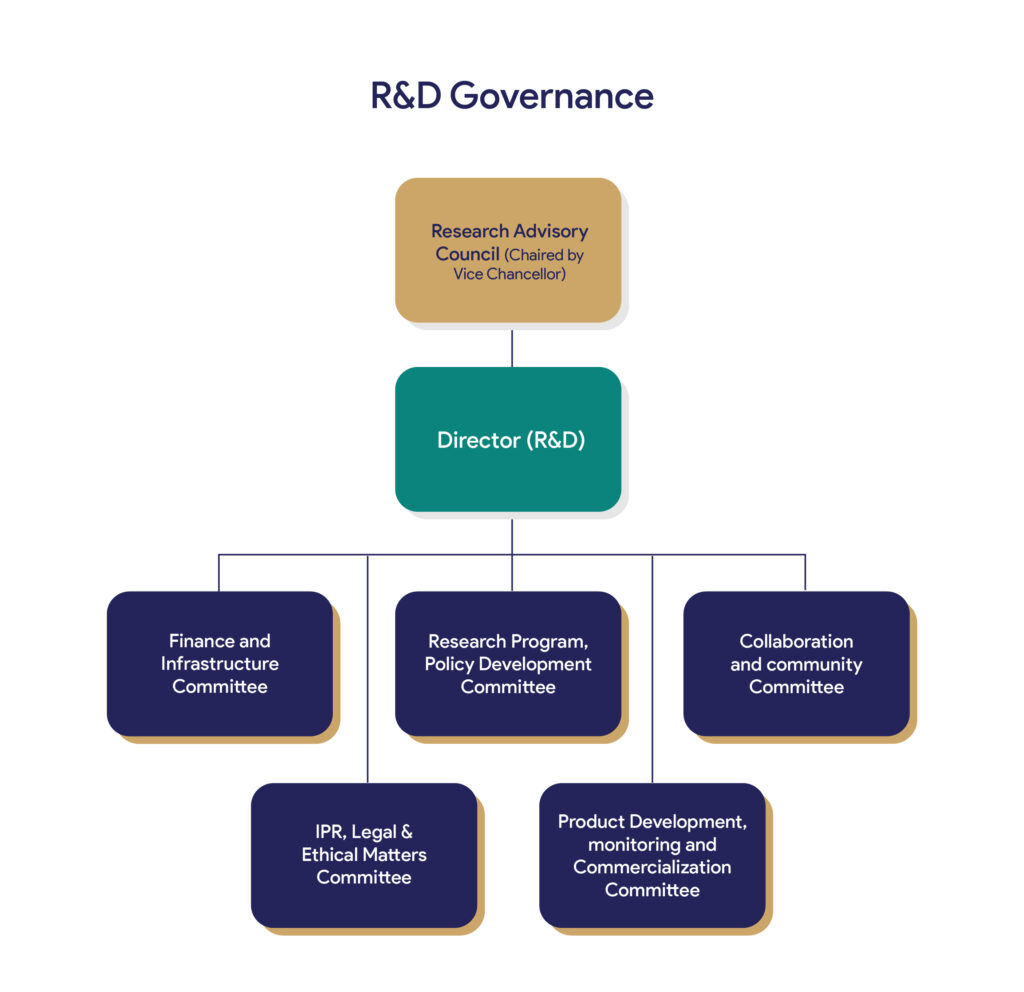
Research Advisory Council
| Role | Designation | Name |
|---|---|---|
|
Chairman |
Hon’ble Vice Chancellor (Acting) |
Prof. T. Asokan |
|
Member |
Professor of Practice
|
Prof. Ramesh Pattni |
|
Member |
Dean Academics |
Prof. T. Asokan |
|
Convenor |
Professor, Director-RDC |
Prof. Savitesh Madhulika Sharma |
Committee 1: Finance & Infrastructure
| Role | Designation | Name |
|---|---|---|
|
Convenor |
Dean Academics |
Prof. T. Asokan |
|
Member |
Professor, Director – RDC
|
Prof. Savitesh Madhulika Sharma |
|
|
Finance Officer |
Mr Jayakrishnan Jayakumar |
|
|
Chief Operations Officer |
Mr Bhavesh B. |
|
|
Manager – Projects |
Mr Suresh Babu |
Committee 2: Research Program Policy, Development
| Role | Designation | Name |
|---|---|---|
|
Convenor |
Director IQAC, Registrar (Acting) |
Dr Rajendran P. |
|
Member |
HoS – CKS |
Prof. Manjula R. Iyer |
|
|
HoS – LLS |
Dr M. Sudarshan Chiplunkar |
|
|
Principal i/c – CVV IST |
Dr Anand H. S. |
|
|
HoS – Kalayoga |
Dr Atul Kamble |
|
|
HoS – PPSH |
Dr Satheesh Varma M. |
|
|
HoS – EGCS |
Dr Pramod D. |
|
|
HoS – VKS |
Mr Karthik Sharma K. |
|
|
Senior Assistant Professor, PPSH |
Dr Vidyeswari V. |
|
|
Assistant Professor, CVV IST |
Dr Soumya Haridas |
|
|
Assistant Professor – CVV IST |
Dr Shiju E. |
|
|
Assistant Professor – CVV IST |
Dr Raisun Mathew |
Committee 3: Collaboration & Community
| Role | Designation | Name |
|---|---|---|
|
Convenor |
Dean of Student Affairs |
Dr Sunitha Grandhee |
|
Member |
Professor (Guru) – Kalayoga |
Guru. Abhijit Banerjee |
|
|
Associate Professor, LLS |
Dr L. Sampath Kumar |
|
|
Associate Professor/Programme Director MBA – CVV IST |
Dr Ambily A. S. |
|
|
Associate Professor – CVV IST |
Dr Prajith P. K. |
|
|
Assistant Professor – CVV IST |
Ms Anupama Jims |
|
|
Senior Assistant Professor – CVV IST |
Dr Resmi N. Ganga |
|
|
Assistant Professor – LLS |
Dr Rajnish Kumar Mishra |
|
|
Assistant Professor – CVV IST |
Dr Rakhy K. S. |
|
|
Associate Professor – EGCS / Asst. Dean Student Culture |
Dr Bindu M. P. |
Committee 4: IPR, Legal & Ethical Matters
| Role | Designation | Name |
|---|---|---|
|
Convenor |
Senior Assistant Professor, PPSH |
Dr Vidyeswari V. |
|
Member |
Associate Professor CVV IST/Asst.Deanlearning and innovation |
Dr Praveen K. M. |
|
|
Assistant Professor, CVV IST |
Dr Sayan Kumar Pal |
|
|
Assistant Professor, LLS |
Dr Avijit Ghosh |
|
|
Assistant Professor, CVV IST |
Dr Mohini Billore |
Committee 5: Product Development Monitoring & Commercialization
| Role | Designation | Name |
|---|---|---|
|
Convenor |
Associate Professor, CVV IST |
Dr Kavitha Rajan |
|
Member |
Assistant Professor, CVV IST
|
Dr Nivetha S. |
|
Member |
Assistant Professor, CVV IST
|
Dr Robin George |
Research Centers
Recognised School / departments and their areas of research
School of Vedic Knowledge Systems(VKS): Research in classical Sanskrit literature, Vedic texts and related fields.
School of Philosophy, Psychology, and Scientific Heritage (PPSH): Focus on Indian psychology, counselling psychology, clinical psychology, art therapy, and industrial-organisational psychology.
School of Contemporary Knowledge Systems (CKS): Research in business ethics, corporate social responsibility, sustainable business practices, finance, organisational behaviour, human resources, marketing, and rural studies.
School of Ethics, Governance, Culture, and Social Systems (EGCS): Studies in educational psychology, educational management, pedagogical interventions, and sociology of education.
School of Linguistics and Literary Studies (LLS): Research in classical and modern literature, including Sanskrit, Hindi, and English, with areas like Ramayana studies, Vedic literature, Alankara Shastra, psycholinguistics, language acquisition, and language pedagogy.
School of Kalayoga: Focus on traditional Indian arts, including Hindustani and Carnatic music, and related fields.
CVV Institute of Science and Technology (CVV-IST): Research in engineering and technology, including image processing, machine learning, deep learning, bio-inspired computing, health informatics, VLSI, semiconductor devices, nanotechnology, photonics, and material science.
Thrust Areas
| Name of the School | Specialisation | Major Research Areas |
|---|---|---|
|
School of CKS |
Commerce and Management |
Business Ethics, Corporate Social Responsibility, Corporate Governance, Entrepreneurship and Innovative Business Practices, Finance, Sustainability Business Ethics, Marketing |
|
|
|
Organisational Behaviour, HR, Marketing, Finance, Rural Studies, Finance, Taxation, Banking, International, Marketing, Operations, Insurance |
|
School of Kalayoga |
Music |
Percussion Instruments of Hindustani Music |
|
|
|
Music Related |
|
|
|
Hindustani Vocal and Instrumental Music |
|
School of PPSH |
Psychology |
Industrial and Organisational Psychology, Psychology, Indian Psychology (Prefer Internal Candidates) |
|
|
|
Industrial & Organisational Psychology, Psychology, Positive Psychology |
|
|
|
Counselling Psychology, Clinical Psychology, Art Therapy |
|
School of EGCS |
Education
|
Education, Educational Psychology, Education Management, Educational Technology, Methodology and Pedagogy, Teacher Education, Education Policy, Sociology of Education |
|
|
Mathematics |
Mathematics – Graph Theory, Operations Research, Mathematics Education, IKS-CKS Integration in Mathematics |
|
Centre for Interdisciplinary Research |
Computer Science and Engineering |
Bio-Inspired Computing, Health Informatics, Association Mining, Algorithm Analysis and Development, Machine Learning, Application Development, Optimisation, Big Data Analysis, Security |
|
|
Mathematics |
Analytic Number Theory, Wavelet Analysis, Harmonic Analysis, Fourier Analysis, Functional Analysis |
|
|
Electronics and Communication Engineering |
VLSI, Device modelling, AI Chip, Microprocessor, Semiconductor Devices, Nano-Devices, IOT, Image Processing, CNT, High Frequency Devices, MOSFETs, FINFETs, Embedded Systems |
|
|
Chemistry |
Biomaterials, Coordination Chemistry, Bioinorganic Chemistry, Phytochemical Extraction, Nanocomposites, Tissue regeneration, Catalysis, Anti-Cancer Studies and Chemical Biology |
|
|
Physics |
Light-matter Interactions in Photonic Architectures, Nonlinear Optics, Nanostructures, Organic-Inorganic Nanohybrids, Liquid Crystals, Plasmonics, Laser Ablation, Luminescence Spectroscopy, Metamaterials |
|
School of LLS |
Vedic Literature
Sanskrit Literature
IKS
|
Vedas and Vedangas,
Classical Literature, Alaṅkāraśāstra, Purāṇa & Itihāsa
Caturdaśavidyāsthāna
Manuscriptology
Sanskrit Poetics
|
|
|
Hindi Literature |
Media Studies, Journalism |
|
|
English Literature |
Identity, Diaspora and Gender Studies |
|
Robotic and Automation Research Centre |
Health care |
Human-Centric, Healthcare & Assistive Robotics, Healthcare Service & Hospital Automation Robots, Wearable, Soft & Bio-Inspired Medical Robots |
|
|
Defense |
UGV, AGV, Drone |
|
AI Research Innovation Centre |
Health AI |
Medical AI, IKS Integration of health data |
|
|
Oceanic AI |
Autonomous Marine Systems, Polar Expeditions & Cryosphere Studies, Coral Reef Monitoring, Ocean Data Analytics, Robotics for Harsh Environments |
|
Centre of Excellence for IKS-CKS Integration and Innovation
|
|
• Mental health AI, IKS Integration of AI with pranayama practices
• Construction of measurement instruments for Psychological testing based on IKS
• Traditional art forms and their social and psychological effects
• Teaching pedagogies based on IKS for the transformation of teaching
• Kerala mathematics and applications in CKS |
|
Centre for Optics and Photonics |
|
|
|
Centre for Biomaterials and Sustainable Chemistry |
Biomaterials
Translational Medicine
|
Biopolymers, Biocomposites |
IRINS
Indian Research Information Network System
Explore our faculty’s complete research portfolio on the official IRINS database.
Incubation & Entrepreneurship
Institution’s Innovation Council (IIC)
In the year 2018, the Ministry of Education (MoE), Government of India, established its’ Innovation Cell’ at All India Council for Technical Education to systematically foster a culture of Innovation at Higher Educational Institutions (HEIs). MoE’s Innovation Cell established the Institution’s Innovation Council (IIC) to engage, encourage, and channelising creating minds of Indian Youth to build innovations and enterprises. Primarily, IIC’s role is to engage a large number of faculty, students and staff in various innovation and entrepreneurship-related activities such as ideation, Problem-Solving, Proof of Concept development, Design Thinking, IPR, project handling and management at the Pre-Incubation/Incubation stage, etc., so that the innovation and entrepreneurship ecosystem gets established and stabilised in HEIs.
Mission
• To create an ecosystem to incubate and support innovative ideas.
• Nurture and train students to develop the qualities of global professionals.
• To create entrepreneurship opportunities for students, faculty and Research Scholars.
• To nurture the startups by providing them necessary support.
• To provide support to commercialise innovative & sustainable ideas and to protect Intellectual Property Rights.
Vision
To build up an ecosystem which will foster the culture of Innovation among students, Alumnae and faculty members from idea generation to pre-incubation, incubation and graduating from the incubator as successful start-ups.
Major Focus of IIC
• To create a vibrant local innovation ecosystem.
• Start-up/ entrepreneurship supporting Mechanism in HEIs.
• Establish a Function Ecosystem for Scouting Ideas and Pre-incubation of Ideas.
• Develop better Cognitive Ability amongst Technology Students.
Functions of IIC
• Promote innovation in the Institution through multitudinous modes, leading to an innovation promotion eco-system on the campus.
• To conduct various innovation and entrepreneurship-related activities prescribed by Central MIC in time bounded fashion.
• Identify and reward innovations and share success stories.
• Organise periodic workshops/ seminars/ interactions with entrepreneurs, investors, professionals and create a mentor pool for student innovators.
• Network with peers and national entrepreneurship development organisations.
• Create an Institution’s Innovation portal to highlight innovative projects carried out by the institution’s faculty and students.
• Organise Hackathons, idea competitions, mini-challenges, etc., with the involvement of industries.
Activities conducted
• Institution’s Innovation Day 2023
• Internal Hackathon for Smart India Hackathon (SIH) 2023
• IIC Regional Meet – Kochi 2024 (16 January 2024)